
A choking emergency is one of those situations most of us would rather not think about until we have to. It can happen at the dinner table, while a child is eating, or when an older family member is having a meal, and there is very little room for hesitation when somebody suddenly cannot breathe. That is probably why the NovaCare One-Button Anti-Choking Device caught my attention. Instead of the familiar manual suction devices that require you to position the mask and physically pull a plunger, NovaCare is designed around a much simpler idea: place the mask over the mouth, press the button, and let the device create the suction.
At first glance, that sounds like a useful improvement. The company specifically markets NovaCare as an electronic, one-button anti-choking device that can be operated with one hand, including by people who may struggle with the pulling motion required by some manual devices. It comes with adult and child masks, is small enough to store at home, and is being marketed heavily toward families, caregivers and older adults.
But this is not the sort of product where I would stop at the marketing. An anti-choking device is supposed to be there for a genuine emergency, so the questions that matter are much bigger than whether the packaging looks good or whether the button is convenient. Is NovaCare actually FDA authorized? Is it supposed to replace the Heimlich maneuver? Does one-button operation make it safer? What do real NovaCare reviews say? And, perhaps most importantly, what does the FDA currently say about suction anti-choking devices?
After looking into all of that, my view of the NovaCare One-Button Anti-Choking Device is more nuanced than the sales pages make it sound.
What Is the NovaCare One-Button Anti-Choking Device?
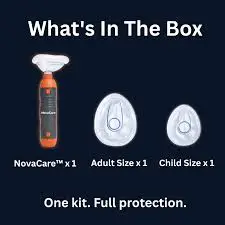
NovaCare is a compact suction device designed to help remove an obstruction from the airway during a choking emergency. The basic idea is straightforward. A mask is placed over the person’s mouth to create a seal, and the device then uses suction rather than the user manually pulling a plunger.
The company describes the device as a one-button system that can be operated with one hand. NovaCare also sells it with two mask sizes, one intended for adults and another for children, which makes the kit more practical for households where more than one age group might need assistance.
The device itself is approximately 16 centimetres, or about 6.3 inches, tall according to the manufacturer’s current product information. That makes it small enough to keep in a kitchen drawer, emergency kit or another easily accessible location rather than treating it like a piece of medical equipment that has to be stored somewhere out of reach.
The concept is appealing, particularly for someone who has difficulty with hand strength. A manual choking device requires a person to perform a pulling motion, whereas NovaCare’s pitch is essentially that you position it and press the button.
That sounds simple, but simplicity on a product page and simplicity during an actual emergency are two different things.
How Does the NovaCare One-Button Choking Device Work?
The NovaCare system is designed around suction. You select the appropriate mask, position it over the mouth, create the seal and activate the device.
The company’s marketing describes the process as “Place and Press,” which is certainly easier to remember than a complicated sequence of mechanical steps. That may be particularly attractive to people buying one for an elderly parent or another family member who might not have the strength to operate a traditional plunger-style device.
NovaCare also says its device does not require batteries and describes it as ready for use when stored properly. The company’s current product page lists a suction strength of up to 300 mmHg, although I would not interpret that number by itself as proof that the device will successfully clear an airway in a real choking emergency.
That is an important point because suction strength on a specification sheet is not the same thing as demonstrated clinical effectiveness. With an emergency device, what matters is whether it performs reliably when the situation is chaotic, the mask seal is difficult to establish, and seconds matter.
Is NovaCare FDA Approved?
This is probably the biggest part of the NovaCare review that deserves clarification.
NovaCare’s website says the product is a Class I FDA-registered medical device and gives FDA registration information associated with the manufacturer. That statement can easily be read by shoppers as “FDA approved,” but those phrases do not mean the same thing.
In fact, NovaCare’s own legal disclaimer makes the point that FDA establishment registration and device listing do not mean FDA approval, clearance, authorization or endorsement.
That is important because “FDA registered” is often used in online product marketing in a way that sounds much stronger than it actually is. Registration and listing are regulatory requirements in certain circumstances, but they should not be treated as a government endorsement that a product has been proven effective.
The FDA’s current choking-device guidance makes this distinction especially important. As of March 4, 2026, the agency said that anti-choking devices marketed in the United States must have the appropriate FDA marketing authorization, and it specifically warned consumers not to confuse establishment registration and device listing with FDA authorization.
So if you are asking, “Is NovaCare FDA registered?” the company says yes. If the question is, “Does FDA registration mean the FDA has approved NovaCare as an effective choking rescue device?” the answer is no.
Those are two very different claims.
What Does the FDA Say About Anti-Choking Devices?
This is where I think anyone considering NovaCare should slow down and read beyond the sales pitch.
The FDA updated its safety communication on March 4, 2026, and its advice is very clear: established choking-rescue protocols from organizations such as the American Red Cross and American Heart Association should be followed first. For adults and children with a complete airway obstruction, these protocols involve established first-aid techniques such as back blows and abdominal thrusts.
The FDA says anti-choking devices may be considered as a second option if established protocols are unsuccessful, but it warns that using a device first could delay critical life-saving action.
That completely changes how I would interpret the NovaCare marketing.
I would not buy this device thinking, “Now I don’t need to learn the Heimlich maneuver.” That would be the wrong takeaway. I would view a suction device as an additional piece of emergency equipment, not as a replacement for knowing what to do when somebody is choking.
The FDA also says it is aware of reports involving anti-choking devices where the device failed to resolve the obstruction because of inadequate suction, as well as reports of bruising around the mouth and face and scratches to the back of the throat.
That doesn’t mean NovaCare specifically caused those incidents. The FDA’s statement concerns anti-choking devices generally. But it is a good reason not to treat any suction device as a guaranteed solution.
Can NovaCare Be Used on Yourself?
One of the most interesting claims surrounding the NovaCare device is its potential for self-rescue.
The idea is appealing. If someone is alone and choking, they cannot rely on another person to operate a device for them. A compact, one-hand-operated device could theoretically give someone another option.
But I would be careful with the way this feature is interpreted.
Self-rescue during choking is a serious emergency, and a product description cannot guarantee that a person will be physically capable of positioning a mask correctly while struggling to breathe. The situation could also involve a partial obstruction rather than a complete airway blockage, which is another reason proper first-aid knowledge matters.
NovaCare’s ability to be held and operated with one hand is certainly an interesting design feature, particularly compared with manual plunger-style products. I just would not turn that into the promise that anyone choking alone will necessarily be able to save themselves with the device.
NovaCare for Seniors: Is the One-Button Design Better?
This is probably where I can understand the appeal of NovaCare more than anywhere else.
Some older adults have reduced grip strength, arthritis or difficulty performing forceful pulling motions. A device that requires one button rather than a strong manual pull may therefore feel much more approachable.
NovaCare specifically markets the one-button concept toward seniors and people who may have difficulty with traditional manual devices. The design is also compact, so keeping it near the dining area would be practical.
But there is a difference between being easier to operate and being medically superior.
I would describe the one-button design as a convenience feature, not proof that NovaCare is more effective than every competing anti-choking device. The FDA’s guidance remains the same regardless of whether the suction device is manual or electronic: established choking protocols come first.
What Are Customers Saying?
The customer feedback is actually more mixed and interesting than simply calling all the reviews positive or negative.
NovaCare’s Trustpilot profile currently shows a generally positive rating, but there are only a relatively small number of reviews compared with a long-established consumer product. Some customers praise the construction, packaging and support they received from the company. One recent reviewer initially believed the device was defective but said NovaCare support walked them through the operation and helped them get it working. Another reviewer complained about shipping time and packaging, including concerns about how the package appeared when it arrived.
That is useful information because it shows that the real customer experience isn’t simply “ordered it, opened it, perfect.”
There are people who appear happy with the product, but there are also customers who have had questions about operation, shipping or packaging. I would take those reviews for what they are: customer experiences, not proof that the device will succeed or fail in a real choking emergency.
And that distinction matters more here than it would with something like a kitchen gadget. You can return a disappointing blender. You cannot afford to discover during a choking emergency that you never properly understood how an emergency device worked.
Does NovaCare Need Batteries?
According to NovaCare’s current product information, the device does not require batteries. That is an interesting practical advantage because it removes one of the annoyances associated with emergency equipment: discovering that the batteries have died after the device has been sitting unused for months.
Still, “no batteries required” should not be confused with “maintenance free.” Emergency equipment should be stored where it can actually be reached, and anyone who buys NovaCare should become familiar with the masks, instructions and operation before an emergency occurs.
The FDA specifically advises consumers who choose to purchase an anti-choking device to familiarize themselves with the device and its instructions before an emergency happens.
That is advice I would take seriously.
What About the NovaCare Deepfake and Fake Doctor Ads?
There is another issue worth mentioning because anti-choking products have become heavily marketed through social media.
Some online advertisements in this category have used dramatic testimonials, medical-looking endorsements and, in some cases, allegedly manipulated or unauthorized likenesses of healthcare professionals. That kind of advertising can make a product look much more medically established than it actually is.
I would not judge NovaCare’s effectiveness based on a viral video featuring a doctor, celebrity or pediatric expert unless the endorsement can be independently verified.
A polished advertisement isn’t clinical evidence, and a person appearing in a video doesn’t necessarily mean they have endorsed the product.
This is particularly important for medical and emergency products because people naturally give more weight to anything that appears to come from a healthcare professional. The safest approach is to separate the advertising from the underlying evidence and regulatory information.
NovaCare vs. LifeVac: What’s the Difference?
The most obvious difference is the operating mechanism.
LifeVac is a manual suction device that uses a plunger-style action, while NovaCare is designed around electronic one-button operation. For somebody who struggles with grip strength, that difference could make NovaCare more attractive.
But I wouldn’t automatically conclude that electronic operation means NovaCare is more effective.
Interestingly, the regulatory situation around anti-choking devices has also changed recently. On March 4, 2026, the FDA granted a De Novo classification for LifeVac as a suction anti-choking device intended as a second-line treatment.
That does not automatically validate NovaCare, and it doesn’t mean every suction device works the same way. It simply reinforces the point that shoppers need to look at the specific device rather than assuming that “FDA registered,” “FDA approved,” and “FDA authorized” all mean the same thing.
Is NovaCare a Scam?
I would not call NovaCare a scam simply because it is a relatively new anti-choking product or because the company uses strong marketing language.
There is a real product being sold, the company provides product specifications and customer support, and customers have posted reviews describing receiving and using the device. The bigger issue is how consumers interpret the company’s regulatory claims and what they expect the device to do.
NovaCare itself states that its product is FDA registered and listed, while also acknowledging that registration and listing are not the same as FDA approval, clearance, authorization or endorsement.
So the more useful question isn’t “Is NovaCare a scam?” It is “Is NovaCare being marketed in a way that could make people think it is an FDA-approved replacement for established choking first aid?”
That is where I would urge buyers to be careful.
The FDA does not tell people to replace established choking protocols with suction devices. Its current guidance says those protocols should come first, with anti-choking devices considered afterward if the initial measures are unsuccessful.
Who Might Consider Buying the NovaCare Device?
I can see why a family might want one.
If you have young children, older relatives, caregivers in the home, or simply want an additional emergency device available in the kitchen, the compact size and one-button operation are attractive features. The adult and child masks also make it more versatile for a household rather than something designed for only one person.
But I would only consider it as backup equipment.
I would not buy NovaCare instead of learning choking first aid. I would not put it somewhere inaccessible and assume that having it in the house means everyone is prepared. And I definitely would not wait until an emergency to open the package for the first time.
The device should be familiar before it is ever needed.
What I Think Of the NovaCare One-Button Anti-Choking Device
After looking at the design, the company’s claims, the customer feedback and the FDA’s current position, I think NovaCare is an interesting emergency device, but the marketing needs to be viewed with realistic expectations.
The one-button design is genuinely appealing. Compared with a manual suction device, the idea of being able to position the mask and activate suction without performing a forceful pulling motion could be useful for somebody with limited hand strength. The compact size, adult and child masks and battery-free design also make it practical to keep around the home.
Where I would draw the line is treating NovaCare as a substitute for established choking rescue procedures.
The FDA’s March 2026 guidance is very clear that people should follow established choking protocols first and consider anti-choking devices as a second option when those measures have not worked. The agency also warns that device preparation and use could delay critical first aid if people reach for the gadget before performing the established procedures.
I also would not let the phrase “FDA registered” persuade me that NovaCare has received an FDA endorsement. NovaCare’s own legal disclaimer says registration and listing do not mean FDA approval, clearance, authorization or endorsement.
Conclusion
So, is the NovaCare One-Button Anti-Choking Device legit? It appears to be a real product being sold by a real company, and there are customers reporting positive experiences with the device and its support. But I would buy it only as an additional emergency tool, not as a replacement for proper choking first-aid training or established rescue procedures.
For a product that could one day be needed during a genuinely frightening few minutes, that is the standard I would use. The best anti-choking device is not the one with the most impressive advertisement or the biggest number on the product page. It is the one you understand, have available when needed, and use without abandoning the first-line rescue steps that medical authorities recommend.