
Finding bed bugs in your apartment is one of those problems where you start looking for anything that might make them disappear without turning your whole bedroom upside down. That was pretty much where I was when I bought the PestLab Pest Repeller. The idea sounded appealing enough: plug the little device into the wall, let it send out ultrasonic and electromagnetic waves, and supposedly the pests will eventually decide they would rather live somewhere else. It is marketed as a chemical-free pest control device for mice, rats, roaches, ants, spiders, mosquitoes and bed bugs, with one unit advertised as covering up to 300 square feet of open indoor space.
I was not expecting some magical overnight solution, either. The instructions and product claims suggest that it can take up to two weeks, so I gave it that time while continuing with other bed bug control methods, including traps, sprays and powder. I figured the PestLab could at least be another layer of protection while I dealt with the infestation properly. More than two weeks later, though, I was still finding bed bugs in several places around the mattress, including areas surprisingly close to the PestLab unit itself. The indicator light was on, so the device appeared to be operating, but whatever ultrasonic protection it was supposed to provide was not producing the result I bought it for.
What Is the PestLab Pest Repeller Supposed to Do?
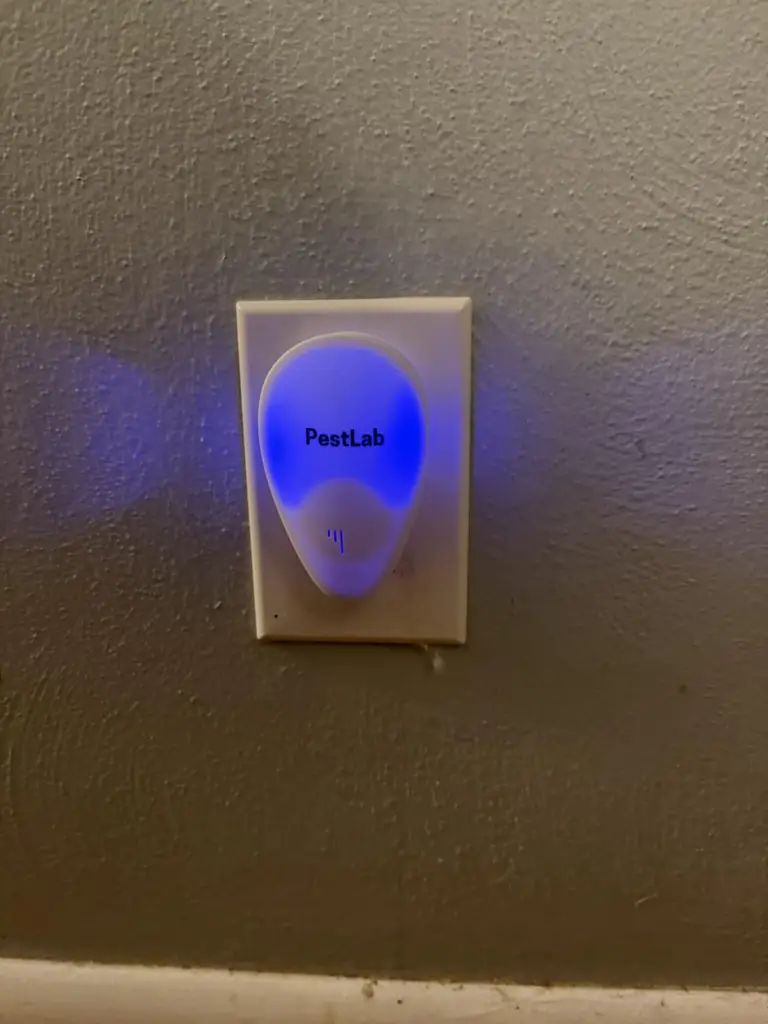
The PestLab Pest Repeller is a small plug-in electronic pest control device designed to operate without the smell, residue or mess associated with conventional insecticides. The basic idea behind these products is that the device emits high-frequency sound intended to be unpleasant or disruptive to pests while remaining inaudible or barely noticeable to people. PestLab also promotes electromagnetic waves as part of its approach, and the product is marketed for a surprisingly wide range of pests, including rodents and insects.
The 300-square-foot coverage claim sounds useful on paper, particularly if you are trying to protect a bedroom, office or other relatively small room without spraying chemicals everywhere. The product is also advertised as safe around children and pets and designed to operate silently. Those are attractive features when you are already dealing with something as unpleasant as bed bugs because nobody wants to spend weeks sleeping in a room filled with strong chemical odors or constantly setting off sprays. The problem is that convenience only matters if the device actually has a meaningful effect on the pest you are trying to control.
My PestLab Experience With Bed Bugs
My reason for buying PestLab was simple: I found bed bugs in my apartment and wanted something that could help while I worked on the infestation. I understood that the device claimed it could take up to two weeks, so I did not plug it in one night and expect the bugs to disappear by morning. I left it running and continued using other methods because I was not willing to sit around waiting while bed bugs continued reproducing.
That two-week period was long enough to give the device a fair chance, at least from my perspective. What I saw afterward was not encouraging. I found several bed bugs around the mattress, including some that were chilling out surprisingly close to where the PestLab device was plugged in. The little light on the unit was still on, which told me that it had power, but the fact that the bugs were still there made the whole ultrasonic repeller claim difficult for me to take seriously. If the device is supposed to make an environment unpleasant enough for bed bugs to leave, seeing them remain nearby after more than two weeks is not exactly the result I was hoping for.
This is also why I would not confuse the device being powered on with the device actually working as advertised. The light can tell you that electricity is reaching the unit; it cannot tell you whether the ultrasonic output is having any meaningful effect on bed bugs. From a buyer’s point of view, that distinction matters because there is no obvious way to look at the device and know that it is actually repelling anything.
Does PestLab Ultrasonic Repeller Work on Bed Bugs?
This is where my experience lines up with something more important than marketing claims: there is published research specifically examining commercially available ultrasonic pest repellers and bed bugs. A study published in the Journal of Economic Entomology tested four commercial ultrasonic repellent devices and found that female bed bugs were equally likely to occur in areas with and without the ultrasound. The researchers concluded that the commercial ultrasonic devices tested were not a promising method for repelling bed bugs.
That study does not mean every electronic pest device on the market is identical, and it was not a test of the specific PestLab model I purchased. Still, it is hard to ignore when a product is being sold specifically as an ultrasonic bed bug repeller. The basic promise depends on bed bugs responding to the sound strongly enough to leave the area, while the published research found no meaningful repellent effect from the commercial ultrasonic devices tested. My own experience certainly did not give me a reason to believe PestLab had somehow overcome that problem.
The wider problem with using an ultrasonic device for an actual bed bug infestation is that bed bugs are not simply insects wandering around your room waiting for something to annoy them. They hide in mattresses, box springs, bed frames, cracks, crevices and other protected locations, and an infestation can involve eggs as well as adults and nymphs. The U.S. Environmental Protection Agency recommends an integrated approach involving inspection, monitoring, cleaning and appropriate control methods rather than relying on one supposed quick fix.
The 2-Week Claim Didn’t Convince Me
I think the two-week timeframe is one of the things that can make this type of product especially tempting when you are desperate to get rid of bed bugs. You can tell yourself that you only need to be patient and give the device enough time to do its job. I was willing to do exactly that, which is why I kept the PestLab plugged in while continuing with other treatments instead of judging it after a day or two.
But once those two weeks had passed and I was still finding bed bugs around the mattress, including near the device, I was left with the same problem I started with. There was no obvious improvement that I could reasonably attribute to PestLab. The light was on, the unit was plugged in, and it was presumably doing whatever the electronics were designed to do, but the bed bugs did not appear particularly bothered by it.
For someone dealing with a genuine infestation, that matters much more than whether the product looks modern or is convenient to plug in. Every week spent relying on something that does not control the infestation is another opportunity for bed bugs to remain hidden, lay eggs and spread into other parts of the room or apartment. The EPA specifically advises people dealing with bed bugs to keep inspecting affected areas and surrounding living spaces because treatment often requires repeated attention rather than a single product or one-time application.
What About PestLab Reviews on Amazon?
The customer feedback I found is mixed, which is worth mentioning because this is not a situation where every buyer appears to have had exactly the same experience. Product listings associated with the PestLab ASIN show both positive and negative experiences, with some customers saying they noticed fewer bugs after using the devices while others reported that the product did not make a difference. One listing currently shows a rating in the mid-three-star range, although the exact review count and rating can change as additional purchases and reviews are added.
That mixed feedback is another reason I would not tell somebody that every person who buys PestLab is guaranteed to waste their money. Some people may notice fewer pests after plugging in an electronic repeller, but that does not establish that the ultrasonic waves caused the improvement. Pest activity can change for plenty of reasons, especially when someone is simultaneously cleaning, spraying, trapping, sealing entry points or using other pest-control products.
For me, the more important question was much narrower: Did PestLab solve the bed bug problem I bought it to help with? After giving it more than two weeks while continuing other methods, my answer is no.
Is PestLab a Scam?
I would not describe PestLab itself as a scam simply because it did not work for me. It is a real electronic device being sold as a pest repeller, and the product makes specific claims about ultrasonic and electromagnetic technology. The bigger issue is whether those claims translate into effective bed bug control, and my experience gives me little reason to recommend it for that purpose.
There is also a difference between saying a product is ineffective for a particular pest and saying that the company has deliberately deceived every customer. I cannot make that leap based on one purchase and a mixed collection of customer feedback. What I can say is that the bed bug claim deserves a lot more skepticism than the simple plug-it-in-and-wait presentation suggests, especially when research on commercial ultrasonic devices has already found poor results against bed bugs.
What I Would Do Differently for Bed Bugs
If I were starting over, I would put my money and time into methods that have a more established role in bed bug control instead of treating an ultrasonic repeller as the main solution. The EPA recommends an integrated pest management approach, which can include careful inspection, mattress and box-spring encasements, bed bug interceptors, appropriate heat or steam treatment, monitoring and properly labeled pesticides when necessary.
I also would not start randomly spraying everything in the room just because I was frustrated. Bed bug treatments need to be used carefully, and the EPA warns against unsafe DIY approaches such as using excessive pesticides, inappropriate products or unregistered substances. It specifically recommends using products registered for bed bug control and following their labels.
That is probably the biggest lesson I took from buying PestLab. When you see a bed bug crawling across your mattress, the temptation is to buy anything that promises to make the problem disappear without much work. I completely understand that temptation because that is exactly why I bought this device. But bed bugs are persistent, and a small plug-in gadget is a much easier solution to sell than an actual infestation is to eliminate.
What I Think Of PestLab Pest Repeller
After buying and using the PestLab Pest Repeller because I had bed bugs in my apartment, I would not buy it again for this purpose. I gave it more than the advertised two-week period, kept it running while I continued using traps, sprays and powder, and still found several bed bugs around my mattress, including close to the device. The fact that its indicator light remained on did not change what I was seeing in the room.
The published evidence also makes me even less enthusiastic about relying on an ultrasonic pest repeller for bed bugs. Research specifically testing commercial ultrasonic devices found that they did not repel bed bugs, while the EPA’s current guidance recommends a much more comprehensive approach to controlling an infestation.
Conclusion
So, is PestLab Pest Repeller worth it? For general pest prevention, I would leave room for individual experiences to vary, but for an existing bed bug infestation, I would save my money. My experience was not that the device made the bugs slowly disappear; it was that the bugs carried on as though the little box plugged into the wall was not particularly interesting to them.
If you are looking at PestLab because you have just discovered bed bugs, I would not make this your main treatment. Use proper monitoring and proven control methods instead, and if the infestation is established or keeps coming back, getting professional help can save you from spending weeks trying products that were never capable of solving the problem in the first place.
Check Out The Zappify review I talked about earlier.