
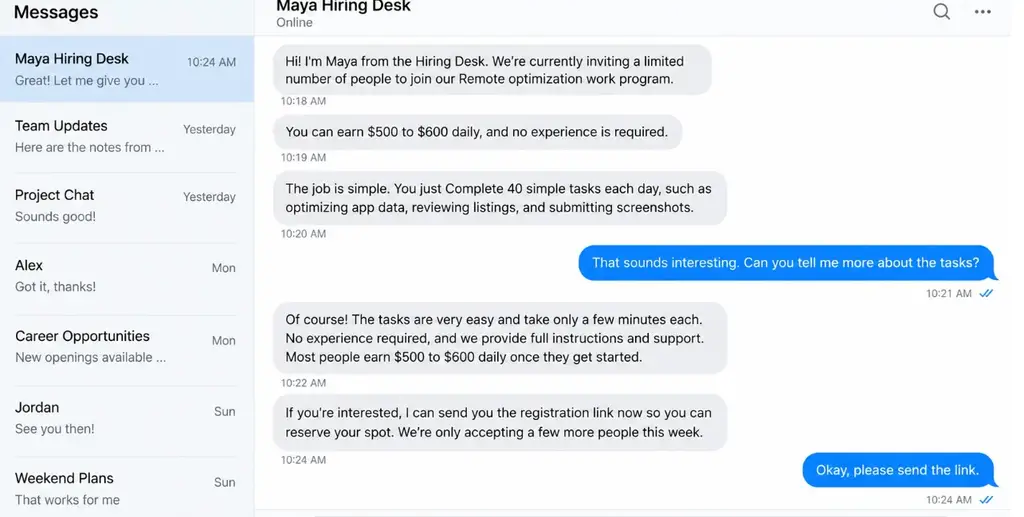
The first message can look like a pretty ordinary job opportunity. Someone you have never heard from contacts you through WhatsApp, Telegram, text message or social media and says they are recruiting people for simple online work. The hours are flexible, you do not need much experience, and the pay sounds surprisingly good for something that apparently involves little more than clicking through a few tasks. They may call the work a cron job, app optimization, product boosting, data submission or online marketing.
At first, there may not even be anything obviously alarming about it. You complete a few tasks, the platform shows that you have earned money and, in some versions of the scam, you may even receive a small payment. That little payout is important because it makes the opportunity feel real. You start thinking that perhaps you have found one of those obscure online side hustles that nobody talks about. Then the platform gives you another batch of tasks, your supposed earnings increase and suddenly you are told that you need to put some of your own money into the account before you can continue or withdraw what you have already earned.
That is where the entire story changes. You were contacted because the company supposedly wanted to pay you for work. Now you are being asked to pay the company. The Federal Trade Commission describes this type of fraud as a task scam or gamified job scam, and the agency says scammers commonly use terms such as “product boosting” and “app optimization” before asking workers to deposit their own money, usually in cryptocurrency.
What Is the Cron Job Task Scam?
The name “cron job” can make this scheme sound more technical than it really is. In legitimate computing, a cron job is simply a scheduled task that runs automatically on a system. It is a real technical term, but that does not mean a person offering a mysterious “cron job” opportunity online is offering legitimate programming work.
In these scams, the terminology can be used to make an otherwise vague job sound professional. You may be told that you are helping a company optimize products, improve an app, increase online visibility or process data. The actual tasks can be remarkably simple, sometimes involving repeated clicks, ratings or selections inside a website or app.
The important part is not the name the recruiter gives the work. It is what happens when you try to get paid.
The FTC says task scams typically begin with an unexpected message offering online work and then move the victim onto a platform where the tasks and supposed commissions are displayed. The platform makes it look as though the worker is steadily building up earnings, even though those earnings are fake.
The Job Usually Starts Out Almost Too Easily
This is one reason people fall for these scams without realizing what is happening.
Imagine receiving a message saying that a company is hiring remote workers to help optimize products. There is no complicated application, no lengthy interview and no requirement for years of experience. You are given a login, shown around a dashboard and told to complete your first set of tasks.
You click a few buttons and suddenly the account shows that you have earned $20, then $50, then perhaps several hundred dollars. The numbers are designed to give you confidence that the system is working.
The work itself may also feel legitimate because there is something happening on the screen. Products appear, numbers change and the account balance increases. It does not feel like someone simply asking you to send money to a stranger. You are supposedly doing work and watching your commission accumulate.
The FTC has reported that some task scammers even pay victims small amounts, often around $5 to $20, specifically to gain their trust before asking for a much larger deposit.
That small payment can be surprisingly effective. Once someone has successfully withdrawn $10 or $20, they may think the platform has already proven itself.
It has not.
Then the Platform Says You Need to Deposit Money
Eventually, the fake job stops being a job.
The platform tells you that you have reached another level, received a special task, triggered a larger order or need to “recharge” your account before you can continue. Sometimes the explanation is that you have been given a high-value task and your balance is temporarily negative. Other times you are told that you must complete the entire task set before your earnings can be released.
Whatever excuse they use, the message is essentially the same: send your own money first, and you will supposedly get it back with your commission.
This is the point at which the scam becomes much easier to identify. A legitimate employer does not require an employee to send cryptocurrency to the employer simply to unlock a paycheck.
The FTC puts it plainly: never pay someone to get paid or to get a job. Its recent guidance on task scams specifically warns that scammers ask victims to deposit their own money, usually in crypto, to complete tasks and withdraw supposed earnings.
If you have reached this stage, the “earnings” displayed on the platform are not money waiting for you. They are numbers being used to persuade you to deposit real money.
Why the Crypto Payment Matters
Cryptocurrency is particularly attractive to scammers running these fake job platforms because the transaction can be difficult to reverse.
The FBI has warned about fake work-from-home opportunities in which victims are told to make cryptocurrency payments to their supposed employer to unlock additional work or earn more money. According to the FBI, the fake platforms show victims that they are earning money, but the displayed balance cannot actually be cashed out.
That creates a nasty psychological trap.
You have already spent time completing tasks. The dashboard says you have earned $800, $2,000 or perhaps even more. The scammer then tells you that all you need to do is deposit another $300 to unlock the withdrawal.
At that point, the $300 feels like an investment rather than a payment. You are not thinking, “I’m sending $300 to a stranger.” You are thinking, “I’m putting in $300 so I can get my $2,000 back.”
But the $2,000 was never really yours.
The Balance on the Screen Is Not Your Money
This is probably the hardest part for victims to accept after they have already deposited money.
The website can display almost any number it wants. Seeing $4,850 in an online dashboard does not mean that $4,850 exists in an account controlled by you.
The number is part of the scam.
Once the victim deposits the first amount, the scammers have a reason to keep the process going. The platform may suddenly generate a larger task that requires another deposit. Then there may be a tax, verification charge, withdrawal fee, security deposit or account-upgrade requirement.
Each explanation is designed around the same promise: pay this last amount and you will finally receive everything.
That promise is what keeps people sending more.
The FTC has described this exact pattern, explaining that victims may “charge up” their accounts with real money because they believe completing another task will allow them to withdraw their supposed earnings. In reality, the displayed earnings are fake and the deposited money is lost.
What Is a “Negative Balance” Task Scam?
One version I would be particularly careful with is the negative-balance trick.
You may complete several ordinary tasks and then receive one supposedly larger assignment. After clicking through it, your account suddenly shows a negative balance. The recruiter tells you that this is normal and that you simply need to add enough cryptocurrency to bring the account back into positive territory.
It can sound technical enough to be believable.
You might be told that the system temporarily used your account balance to complete a transaction, that the merchant requires additional liquidity or that the task cannot be finalized until the negative amount is covered. The recruiter may reassure you that once the task is complete, your entire balance will be available for withdrawal.
The problem is that there is no real employer standing behind the dashboard. The negative balance is simply another number the scammers have created to give you a reason to send more money.
They May Tell You That You Are One Task Away From Getting Paid
This is where people can lose considerably more than they originally intended.
Suppose you have already deposited $500 and the account now shows $4,000 in earnings. You try to withdraw it, but the system says you need to complete one final task.
That final task requires another $700.
You may hesitate, but the recruiter tells you that you have already come this far. Losing $700 would be painful, but losing the $4,000 displayed in your account feels even worse.
So you deposit the money.
Then something else goes wrong.
The account may suddenly require a tax payment. Then a verification fee. Then another deposit because the withdrawal amount is supposedly too large. The numbers keep changing because the goal is not to complete the job. The goal is to keep the victim sending money.
There is no final task.
Fake Recruiters Often Make the Offer Feel Personal
The person who contacts you may not sound like a stereotypical scammer.
They can introduce themselves as a recruiter, hiring manager or representative of a staffing company. They may use a photograph, professional-looking profile and polished messages. The FTC has warned about a newer wave of fake recruiter texts in which scammers claim to represent legitimate companies and offer remote positions before eventually asking the target to send money or complete fake online tasks.
Sometimes the recruiter stays in contact throughout the process. That can make the victim feel as though they have a real person helping them through their new job.
If the victim becomes nervous about making another payment, the recruiter may reassure them that other workers are making money. They may send screenshots or direct them to a group chat where other supposed workers talk about successful withdrawals.
Those people may not be workers at all.
The FTC has noted that task scammers sometimes use group chats filled with supposed experienced workers who encourage newcomers to deposit money. Those “success stories” can be part of the manipulation.
The Fake Job May Be Called Product Boosting or App Optimization
You should not assume that the scam is only called a “cron job.”
The same basic scheme can appear under several different names. You may be offered product boosting, app optimization, online optimization, data submission, merchant tasks, e-commerce tasks, rating tasks, commission tasks or another vague description.
The wording changes because scammers want the opportunity to sound relevant to different people.
Someone interested in marketing might be told they are helping businesses improve product rankings. Someone looking for remote work may be offered “data optimization.” Another person might be told they are helping an app generate engagement.
The FTC specifically identifies product boosting and app optimization as common language in task scams.
The underlying business model remains the same: perform simple tasks, watch fake earnings accumulate, then deposit your own money to continue or withdraw.
Why Would a Company Pay So Much for Clicking Buttons?
This is a question worth asking before getting emotionally invested in the opportunity.
If the supposed job involves clicking buttons, rating products or completing repetitive actions that require almost no experience, why would an ordinary company pay hundreds of dollars a day for it?
The scammers often avoid giving a clear answer. Instead, they use vague explanations about algorithms, product rankings, merchant visibility or optimization. The language sounds technical enough that the victim may assume there is a legitimate business model behind it.
But a genuine employer should be able to explain what the company does, what your actual responsibilities are, who pays you and how the payroll process works.
You should not have to buy cryptocurrency to activate your employee account.
Is the Cron Job Offer a Real Job?
If the offer requires you to deposit cryptocurrency before you can complete tasks or withdraw your supposed earnings, I would treat it as a scam.
That conclusion does not depend on whether the recruiter has a convincing LinkedIn profile, whether the website looks professional or whether the platform lets you withdraw a small amount at the beginning. The requirement that you pay money to access your own supposed wages is fundamentally incompatible with a normal employment arrangement.
The FBI specifically lists being instructed to make cryptocurrency payments to an alleged employer as a warning sign of these fake work-from-home schemes. It also warns that the fake interfaces may show earnings that are not actually available to the victim.
What If You Already Sent Crypto?
If you have already transferred cryptocurrency to the people behind a task scam, stop sending additional payments even if the recruiter promises that one more deposit will release everything.
Do not let the amount you have already lost persuade you to risk another amount. The fact that you have already deposited $1,000 does not make sending another $500 a sensible way to recover it. It simply gives the scammer another opportunity to take your money.
Save the wallet addresses, transaction hashes, messages, screenshots and website addresses associated with the scam. These details can be useful when reporting what happened.
The FTC recommends contacting the company you used to send the money and reporting the fraud, although cryptocurrency transactions can be difficult to reverse. The FBI also asks victims of these fake job schemes to report suspicious activity through its Internet Crime Complaint Center and provide transaction information.
Be careful with anyone who contacts you afterward claiming they can recover your cryptocurrency for an upfront fee. The FBI specifically warns victims not to pay supposed recovery services that promise to get lost cryptocurrency back.
What If You Only Completed the Tasks?
If you have not sent any money, you are in a much better position.
Stop communicating with the recruiter and do not provide additional personal or financial information. If you created an account on the platform using a password that you use somewhere else, change that password on the legitimate service and enable two-factor authentication where available.
You should also be careful about documents you may have uploaded during the supposed hiring process. Fake employers can use job offers to collect personal information in addition to money. The FBI has warned that criminals use fake job listings to persuade applicants to provide personally identifiable information or send money.
A job application should not become an excuse for handing an unknown recruiter unrestricted access to your financial accounts.
Conclusion
The cron job task scam is not a clever new way to make money online. It is another version of the task scam that has been targeting people with fake remote jobs, fake commissions and increasingly aggressive cryptocurrency deposits.
What makes it convincing is that the first part can actually feel like work. You receive tasks, complete them, watch a balance grow and may even receive a small payment. There is enough activity happening on the screen to make the opportunity feel genuine.
Then the platform changes the rules.
Suddenly you need to deposit money to complete a task. You need to recharge the account. You need to cover a negative balance. You need to pay a fee before withdrawing. You need to finish one final task. Each request is presented as a temporary obstacle between you and the money the platform claims you have already earned.
That money is not sitting there waiting for you.
The FTC’s current guidance on task scams describes this exact setup: unexpected job messages lead to simple optimization or product-boosting tasks, fake earnings appear in an app, and victims are eventually told to deposit their own money, commonly in cryptocurrency, to continue or withdraw. The FBI has issued similar warnings about fake work-from-home jobs involving simple tasks, fake earning dashboards and cryptocurrency payments to unlock additional work.
The moment an alleged job tells you to deposit your own crypto so you can withdraw the money you supposedly earned, stop. Whatever the recruiter calls the task, whatever the dashboard says you have earned and whatever the other “workers” in the chat are telling you, the money you see on the screen is not a paycheck. It is the bait.
Check out Mansculpt wave therapy plus that I talked about earlier.