
Sabel Black Seed Oil is an Ethiopian black seed oil supplement sold by Sabel Life, a relatively new online wellness company that has built its marketing around one particular ingredient: thymoquinone. The company says its black seed oil is standardized to 5% thymoquinone, which it presents as the reason Sabel is stronger and more effective than ordinary black seed oil.
That sounds impressive when you first land on the website, especially because Sabel Life doesn’t market this as just another bottle of black seed oil. The sales pages talk about bloating, digestion, energy, brain fog, parasites, biofilm and the idea that many people have been taking ordinary black seed oil without getting enough thymoquinone to make a difference. The company even gives customers a timeline for what they supposedly should notice during the first few weeks and months.
So I wanted to look past the sales pitch and find out what Sabel Black Seed Oil actually is, what the company is promising, what customers are saying about it, and whether there is enough evidence behind the marketing to make me comfortable calling Sabel Life a legitimate supplement company.
What Is Sabel Black Seed Oil?
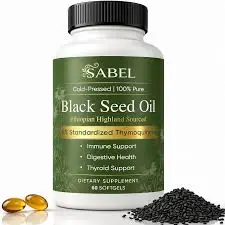
Sabel Life sells its product as Ethiopian black seed oil, also known as Nigella sativa or black cumin oil. The product comes in softgels rather than the strong-tasting liquid form that many people associate with black seed oil. Sabel says each bottle contains 60 softgels, which is intended to provide a 30-day supply at two softgels per day.
The main selling point is the claimed 5% thymoquinone concentration. Thymoquinone is one of the major bioactive compounds found in Nigella sativa, and there is genuine scientific interest in it. Human studies have investigated black seed oil and thymoquinone in areas including inflammation, blood pressure, metabolic health, allergies, sleep and other conditions. A review of clinical trials found evidence worth investigating further, but also noted that many proposed uses still require additional human research.
That part of Sabel’s story is therefore not completely made up. Black seed oil is a real botanical ingredient that has been studied, and thymoquinone is a real compound found in it. The problem starts when the website moves from that general scientific background to much stronger claims about what Sabel itself can supposedly do.
The 5% Thymoquinone Claim
Sabel Life repeatedly emphasizes that its product contains 5% thymoquinone and says this makes it substantially more potent than ordinary black seed oil. The website claims that standard products commonly contain around 0.5% to 1.2% thymoquinone, while Sabel is standardized to 5%. It also says the product is cold-pressed, Ethiopian Highland sourced and third-party tested.
There is an interesting reason to pay attention to the concentration. Researchers have actually tested commercial Nigella sativa products and found that thymoquinone content can vary considerably between products. One published analysis of six black seed oils and five black-seed-containing capsules found a very wide range of thymoquinone concentrations, which supports the general point that the words “black seed oil” alone don’t tell you exactly how much of the active compound you’re getting.
There has also been human research involving a black cumin oil preparation standardized to 5% thymoquinone. A 2022 phase I trial involving 70 healthy adults reported no serious adverse effects after 90 days at the studied dose, although the researchers were specifically studying safety rather than proving all of the health benefits Sabel advertises.
That is why I wouldn’t dismiss Sabel’s 5% claim simply because it sounds like marketing. There is a real scientific basis for paying attention to thymoquinone concentration. What I would question is the leap from “5% thymoquinone has been studied” to “therefore this particular supplement will break down biofilm, clear parasites, eliminate bloating and restore your energy.”
Those are very different claims.
Sabel Life’s Parasite and Biofilm Claims
This is probably the part of the Sabel Life website that made me look most closely at the marketing.
The product page tells visitors that ordinary cleanses supposedly only flush the surface while parasites remain hidden behind biofilm in the gut. Sabel then presents its 5% thymoquinone formula as something capable of disrupting that biofilm and allowing the body to clear what is hiding underneath. The sales page goes on to describe supposed changes in bloating, bowel movements, energy, brain fog, sleep and cravings over several weeks and months.
The website even says that thymoquinone has demonstrated the ability to disrupt biofilm by figures approaching 98–99% in published research. That sounds like the kind of number that would make anyone stop and pay attention, but the context matters. Laboratory findings about antimicrobial or anti-biofilm activity do not automatically demonstrate that taking a supplement will remove parasites or biofilm from a person’s digestive tract.
This is one of the biggest problems I have with the Sabel marketing. The underlying ingredient is legitimate and has been researched, but the website presents a much more certain story about parasites and gut problems than the available human evidence supports.
A clinical review of Nigella sativa found potentially useful effects across several areas, but also concluded that many applications still need further clinical and animal research.
In other words, I would be very cautious about buying Sabel because an advertisement tells you that unexplained bloating, fatigue or brain fog are caused by hidden parasites protected by biofilm. Those symptoms can have many different causes, and the product page cannot diagnose what is happening inside someone’s body.
Sabel Black Seed Oil Reviews: What Are Customers Saying?
This is where the picture gets more complicated because Sabel Life does have independent reviews.
Trustpilot currently shows more than 160 reviews for Sabel Life, with a rating around 4.2 out of 5. Most of the reviews are positive, and many customers praise the company’s customer service and say they have noticed improvements in digestion, bloating or general wellbeing. Trustpilot also shows that Sabel Life responds to negative reviews, which is something I would rather see than a company completely ignoring complaints.
At the same time, the negative reviews are worth reading rather than simply looking at the overall star rating.
There are complaints about delayed deliveries, orders taking weeks to arrive, subscription charges and customers saying they did not realize they had enrolled in recurring orders. One reviewer reported that an order had not arrived after nearly three weeks and said attempts to get support and a refund had been unsuccessful. Sabel Life responded to that complaint and said it would issue a refund and investigate what happened.
Another customer questioned why the bottle itself did not display the claimed 5% thymoquinone concentration. Sabel Life responded that the 5% standardization was part of the product specification but was not printed on every bottle because of packaging and labeling updates.
There are also customers who say the product has helped them. Some report easier digestion, less bloating or improved energy, while others say the customer service team dealt with their questions quickly. There are even recent reviews from customers who say they had subscription or delivery problems but were able to get assistance from Sabel’s support team.
So I wouldn’t describe the Sabel Life reviews as universally negative. They aren’t. The customer feedback is mixed, with plenty of positive experiences alongside complaints about delivery, recurring orders and the product’s effectiveness.
Sabel Life Is a New Company
One thing I would keep in mind before ordering is that Sabel Life has not been around for very long.
The domain sabellife.com was registered on February 22, 2026, according to current domain records. ScamAdviser lists the domain as approximately six months old and notes that the WHOIS ownership information is hidden. Another ecommerce database identifies the store as a Shopify business registered around February 2026.
Again, a young website is not proof of a scam. Plenty of genuine businesses are new. In Sabel Life’s case, however, it means the company does not have the kind of long operating history that would make me automatically comfortable with some of its more ambitious claims.
The company also appears to have built a surprisingly large marketing operation in a short period of time, with multiple sales pages, educational-style articles, testimonials, ebooks and highly specific claims about parasites, biofilm and thymoquinone. That makes it especially important to separate the actual scientific evidence from the company’s sales narrative.
Sabel Life’s Own Customer Numbers Don’t Line Up Perfectly
There is another small thing I noticed while checking the site.
The Sabel Life homepage currently says the company has a 4.8/5 rating based on 20,239+ customers, while the Ethiopian Black Seed Oil product page displays a 4.8 rating based on 3,737+ customers.
That doesn’t necessarily mean anything dishonest is happening. The homepage number could refer to customers across the company rather than just the black seed oil, while the product page could be showing reviews for that particular product. But because Sabel Life is still a relatively new company, I would prefer the website to make those numbers completely clear instead of leaving readers to work out what each figure represents.
It is a small point, but these are the kinds of details I pay attention to when reviewing a young supplement brand.
Sabel Black Seed Oil Price and Subscription
Sabel’s pricing changes depending on the offer being shown. The site currently lists individual bottles around the $35–$40 range against a claimed $65 regular price, while bundle promotions such as Buy 1 Get 1 Free and Buy 2 Get 3 Free are also advertised.
The company also promotes subscriptions, which is something buyers need to notice before completing checkout. Sabel’s own FAQ says customers can subscribe when purchasing multi-bottle offers, and the website has a dedicated subscription-management option.
The existence of a subscription is not automatically suspicious, but some Trustpilot reviewers say they were surprised by recurring orders or did not realize they had signed up for one.
That means I would read the checkout page carefully and make sure the order is set to one-time purchase if that is what you want. With supplements, it is very easy to click on a discounted bundle without realizing that the lower price is connected to a recurring delivery arrangement.
Does Sabel Life Actually Third-Party Test Its Black Seed Oil?
Sabel Life says that every batch is third-party tested and standardized to 5% thymoquinone. It also says the product is made in an FDA-registered, GMP-certified facility.
Those statements sound reassuring, but there is an important difference between a company saying that its products are tested and consumers being able to independently inspect the actual laboratory documentation for the batch they are buying.
I would have liked to see a clearly accessible certificate of analysis showing the laboratory, batch number, testing date and measured thymoquinone content. That would make the 5% claim much easier for a buyer to evaluate.
The fact that the company says it provides third-party testing does not mean the product is fake. It simply means I would prefer to see the underlying documentation rather than relying entirely on the marketing page.
Is Black Seed Oil Backed by Research?
Yes, but the research needs to be kept in perspective.
Nigella sativa has been studied in humans for a variety of potential effects. For example, randomized trials have investigated black seed oil in blood pressure, metabolic health and seasonal allergies, while other research has looked at thymoquinone-rich preparations for sleep and stress.
A 2024 randomized trial involving 65 people with seasonal allergy symptoms reported improvements in several allergy-related measures with a standardized Nigella sativa oil preparation, although that was a specific formulation and a specific condition.
There is also human safety research. A review of the safety literature found that black seed has generally been well tolerated in studies, while also noting that more detailed research is needed for a definitive safety picture.
So the ingredient itself is not some mystery substance invented for Sabel Life. There is legitimate scientific literature on black seed and thymoquinone.
What the research does not establish is that Sabel Black Seed Oil can diagnose or eliminate hidden parasites, remove gut biofilm, cure chronic digestive problems or produce the long list of improvements described on the company’s sales pages.
So, Is Sabel Black Seed Oil Legit or a Scam?
After looking at Sabel Life, I would not call the company a proven scam. There are real customer reviews on Trustpilot, the company responds to complaints, there is an identifiable ecommerce website, and the underlying ingredient, Nigella sativa, has been studied extensively.
At the same time, I would not take all of Sabel Life’s advertising at face value either.
The biggest issue for me is the way the company turns a legitimate ingredient and genuine scientific research into very confident claims about parasites, biofilm and predictable improvements in digestion, energy, brain fog and other symptoms. The human research on black seed oil is interesting, but it is nowhere near enough to establish all of those claims for this particular product.
I also think the company’s young age deserves consideration. Sabel Life’s domain was only registered in February 2026, so it simply has not had years to establish a track record.
The customer feedback is another reason to read the fine print. Many people report good experiences, but there are also complaints involving delayed orders, recurring subscriptions and dissatisfaction with the product.
My biggest takeaway from researching Sabel Black Seed Oil is that the product and the marketing should not be treated as the same thing. Black seed oil is real. Thymoquinone is real. There is genuine research behind Nigella sativa. But that does not automatically validate every health claim made by Sabel Life.
Conclusion
If you are considering buying Sabel Black Seed Oil, I would pay particular attention to the actual supplement facts, the amount of oil and thymoquinone per serving, whether you are purchasing a one-time order or subscription, and whether Sabel can provide a current certificate of analysis for the batch being sold. I would also be wary of buying it because an advertisement has convinced you that unexplained symptoms must be caused by parasites.
As for Sabel Life itself, the evidence I found points to a real but very new supplement business rather than an obvious fake website. Whether the product is worth the money is a separate question, and that comes down largely to how much confidence you place in the company’s 5% thymoquinone claim and its much broader health marketing. For me, the science behind black seed oil is interesting enough to take seriously, but the parasite and biofilm promises on the Sabel Life website go considerably further than the evidence currently allows.
Check out Mansculpt wave therapy plus that I talked about earlier.