
There’s nothing quite like opening your email in the morning and seeing a message thanking you for an order you never placed. That’s exactly what happened to me. The subject line looked completely normal, and at first glance it appeared to be a legitimate shipping confirmation from a company called Best Mama Kitchen.
The email thanked me for my purchase and claimed that my order had already been shipped.
The strange part?
I had never even heard of Best Mama Kitchen before.
If you’ve received a Best Mama Kitchen email or a Best Mama Cooking order confirmation, you’re probably wondering the same thing I did: Is someone using my card, or is this just another phishing scam? Here’s what happened in my case and why I believe this email should be treated with caution.
What Is the Best Mama Kitchen Email?
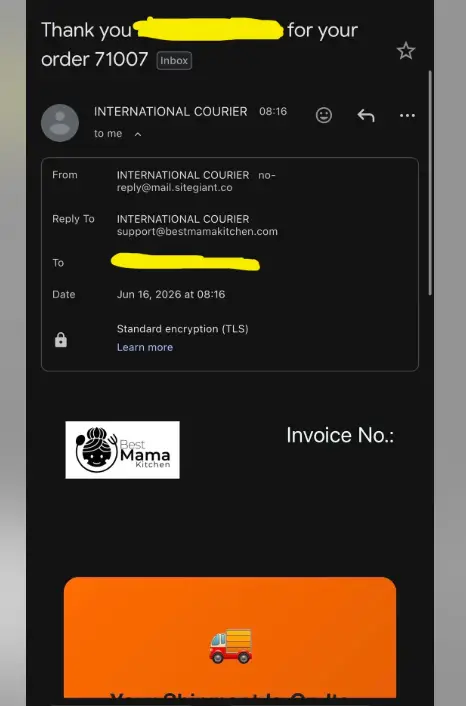
The Best Mama Kitchen email is an unexpected order confirmation or shipping notification that claims you’ve recently purchased products and that your package is already on its way.
The email usually includes details designed to make it feel authentic, such as:
- Your full name.
- Your mailing address.
- A tracking button.
- A shipment notification.
- Order details.
Seeing your personal information inside the email is enough to make almost anyone panic. That’s exactly what happened to me.
My Experience
I opened my inbox one morning and saw an email saying:
“Thank you for your order.”
It went on to say my shipment was already on its way. At first, I genuinely wondered whether someone had somehow used my payment information without me noticing. The email even contained my full name and my mailing address, which made it seem much more believable. The first thing I did was check everything I could think of.
I logged into my bank account. I checked all of my credit cards. I checked my PayPal account. There wasn’t a single charge. Nothing. I also knew I hadn’t ordered anything online for quite a while, so the email immediately stopped making sense. I searched for Best Mama Kitchen online and found that it appeared to sell kitchen supplies, which made things even stranger because it’s not a company I’ve ever bought from. That’s when I decided not to click anything inside the email.
Why I Didn’t Click the Tracking Link
The email included options to track the shipment and view the order.
Normally that might seem like the quickest way to figure out what’s going on. But that’s exactly what phishing emails want you to do. These scams are carefully designed to create urgency. If you think someone has placed an order using your information, your first instinct is to click the tracking link or the cancellation button. That’s precisely why scammers include them. Instead of helping you, those buttons may lead to fake websites designed to steal your passwords, payment information, or other personal details. I decided it wasn’t worth the risk.
How Did They Know My Name and Address?
This is one of the reasons these emails can be so convincing.
In many cases, scammers obtain personal information from older data breaches involving online stores, websites, or leaked customer databases.
That doesn’t necessarily mean your accounts have been hacked today.
It may simply mean your name, email address, and mailing address were exposed years ago and are now being used to make phishing emails appear more convincing.
That’s unsettling, but unfortunately it’s become very common.
What You Should Do If You Receive the Best Mama Kitchen Email
If an email claims you’ve ordered something from Best Mama Kitchen but you never made the purchase, don’t panic.
Instead:
- Check your bank account directly.
- Review your credit card transactions.
- Check PayPal or any payment service you normally use.
- Log into shopping accounts manually rather than through email links.
- Delete or mark the email as spam if no legitimate order exists.
Most importantly, don’t click any tracking links or download any attachments until you’ve confirmed the order is genuine.
Is the Best Mama Kitchen Email a Scam?
Based on my experience, I believe it should be treated as a phishing email unless you can independently verify that you actually placed the order.
The fact that it included my real name and mailing address certainly made it look convincing, but after checking every payment account I have, there was absolutely no evidence that any purchase had been made.
That tells me the email was likely designed to scare me into clicking the links inside it.
Who Can Be Targeted?
Almost anyone with an email address can receive this scam.
Cybercriminals frequently send millions of nearly identical emails using stolen or publicly available email lists. They aren’t choosing victims based on personal information. Instead, they rely on volume, hoping that a small percentage of recipients will believe the threats.
Tips to Avoid Phishing Scams:
- Be Skeptical of Unexpected Communications:
- Be cautious with unsolicited emails, texts, or calls, especially those asking for personal or financial information.
- Verify the Source:
- Always verify the sender’s email address or phone number. Scammers often use addresses or numbers that look similar to legitimate ones.
- Look for Red Flags:
- Check for spelling and grammatical errors, generic greetings (e.g., “Dear Customer”), and urgent or threatening language.
- Don’t Click on Suspicious Links:
- Hover over links to see the actual URL before clicking. If it looks suspicious or doesn’t match the purported sender, don’t click it.
- Check the Website’s Security:
- When entering personal information online, ensure the website is secure. Look for “https://” in the URL and a padlock icon in the browser’s address bar.
- Avoid Downloading Attachments:
- Don’t open email attachments from unknown or suspicious sources. These could contain malware.
- Use Multi-Factor Authentication (MFA):
- Enable factor Authentication on your accounts so as to add an extra layer of security. This makes it harder for scammers to gain access even if they have your password.
- Report Phishing Attempts:
- Report suspicious emails to your email provider and the organization being impersonated. In the U.S., you can forward phishing emails to the Anti-Phishing Working Group at [email protected] and to the FTC at [email protected].
What Do You Do When You Suspect A Phishing Attempt
In this digital age and time, almost everyone has at one time received a phishing text or email and often times they fall victim and get scammed. This is why it is imperative that you are always careful when you receive any text or email because one careless click on a link can cause a whole lot of problems for you. Now if you suspect a phishing attempt, here is what I advise you do:
- Do Not Respond to the text, because you responding is actually giving access to the scammers, simply delete it when you receive.
- Quickly change your password if you have mistakenly clicked on the link or given away your login details. Change your password to a strong and unique password.
- Keep an eye on your accounts for any unauthorized transactions.
- Also scan you devices for any malware.
By following these tips, you can significantly reduce your risk of falling victim to phishing scams and keep your personal and financial information safe.
Conclusion
Receiving a fake shipping confirmation can be alarming, especially when it includes your personal information. For a few minutes, I genuinely wondered whether someone had stolen my payment details or ordered something in my name.
Thankfully, after checking my bank accounts, credit cards, and PayPal, I found no unauthorized transactions at all. If you’ve received the same Best Mama Kitchen order confirmation email, you’re not alone. My advice is simple: don’t click the tracking button, don’t try to cancel the order through the email, and don’t assume it’s legitimate just because it includes your name and address.
Always verify purchases by logging into your accounts directly and checking your payment history yourself. A convincing email can be fake, and scammers know that creating a sense of urgency is one of the easiest ways to trick people into clicking before they stop and think.
Another of these types of scam is the Disney Plus Scam Emails,