
Getting a text telling you that thousands of dollars are waiting for you is the kind of message that can make you stop what you are doing. Maybe the amount is $3,240, $7,500, or some oddly specific figure that looks as though it came from an actual government database. The message may say the money is unclaimed property, a relief payment, a refund, a forgotten settlement, or funds that were recently discovered in your name. Then comes the part that supposedly makes everything easy: click the link, confirm your identity, and claim your money before the deadline expires.
That is where the fake unclaimed money text scam comes in. The money does not actually exist in the way the message suggests, and the link is not there to help you collect a forgotten payment. It is usually a phishing attempt designed to get personal information, financial details, or money from you. The Federal Trade Commission issued a specific warning about these messages on March 30, 2026, after seeing reports of texts and calls telling people they were eligible for thousands of dollars in unclaimed property.
What makes this scam worth talking about is that the idea behind it is not completely ridiculous. There really is such a thing as unclaimed property. States do hold money and other assets that belong to people who have not claimed them. That little bit of truth gives scammers something to build on, because a person who receives a message saying, “We found $4,782 in your name,” may think, “Actually, that sounds possible.”
The problem starts when the text asks you to use its link, provide sensitive information, or pay a fee to receive the supposed money.
What Is the Fake Unclaimed Money Text Scam?
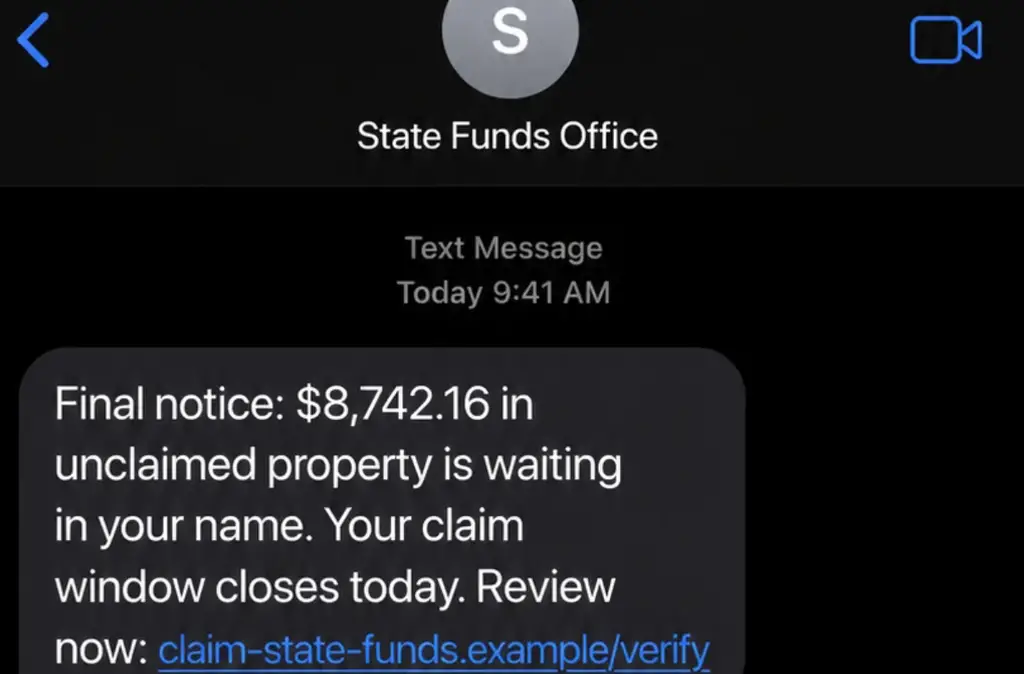
The unclaimed money text scam is a phishing scam built around the promise of money that supposedly belongs to you. The sender may pretend to represent a state treasury, unclaimed property office, government recovery program, settlement administrator, financial institution, or another organization that sounds official.
The wording changes from campaign to campaign, but the basic story is usually familiar. You have money waiting for you, the claim period is supposedly about to expire, and the sender has conveniently provided a link where you can verify your information and collect the funds.
The FTC says scammers may use a real-sounding but fake government agency name and mention a specific amount of money you are supposedly entitled to receive. That amount is there to make the message feel personalized rather than like a random mass text.
Once you click, however, the conversation changes. Instead of receiving money, you may be asked for your full name, address, Social Security number, date of birth, driver’s license information, bank account details, debit card number or other information that can be valuable to an identity thief.
Some versions also ask for a supposedly small processing or release fee. That is another way the scam can turn the promise of free money into an actual financial loss.
The Exact Dollar Amount Is There for a Reason
One detail I would pay close attention to is the amount mentioned in the message.
A generic text saying, “You may have unclaimed money” might not get much attention. But “Your $4,816.27 is waiting” feels completely different. The precise figure makes it look as though somebody has already searched a database and found an account belonging to you.
The FTC specifically warns that scammers use specific amounts to make unclaimed-funds messages more convincing.
It is a clever psychological trick because the recipient starts thinking about the money before thinking about the source of the message. You may find yourself wondering where the money came from, whether you forgot about an old bank account, whether you were included in a settlement, or whether a relative left something behind.
That is exactly the reaction the scammer wants.
A specific dollar amount does not prove that the sender has access to a government database. It can simply be a number chosen to make the story believable.
“You Have Until Midnight” Is Part of the Story
Another common version says you have a limited amount of time to claim the money. Maybe the claim period ends tonight, the funds will be returned to the state tomorrow, or the sender has supposedly extended the deadline just for you.
This is not accidental wording. It is designed to prevent you from slowing down.
The FTC’s March 2026 warning specifically says that if a caller says time is running out, or a text claims the claim period has been extended just for you, that is a scam.
Think about what happens when you believe a deadline is only a few hours away. You are less likely to open another browser and start checking government websites. You are more likely to follow the instructions sitting directly in front of you because you do not want to miss out on money that supposedly belongs to you.
That urgency is what gives the scam its momentum.
Why the Text Can Look Surprisingly Convincing
These messages are not always poorly written. Some use government terminology, official-looking logos, reference numbers, names of agencies and carefully worded explanations about why you supposedly have money waiting.
The website can be even more convincing.
A fraudulent page may contain a government-style header, a search box, a claim number and a form asking you to “verify” your identity. It may even show a message saying your information has been successfully matched.
None of that establishes that the website is connected to a government agency.
The FTC’s broader phishing guidance is worth remembering here: an unexpected message can imitate an organization you recognize and use a link to take you to a fraudulent website. The safest approach is not to trust the link simply because the page looks professional.
This is one of those situations where the appearance of the website is almost irrelevant. What matters is how you arrived there and whether the organization can be independently verified.
Are There Really Unclaimed Funds?
Yes, and this is what makes the scam particularly believable.
State governments really do have unclaimed-property programs. People can have forgotten bank accounts, utility deposits, insurance payments, refunds and other assets sitting in state custody. The existence of legitimate unclaimed property does not make an unexpected text about it legitimate.
The FTC recommends checking your state’s official .gov website rather than clicking a link in an unsolicited message. It also points consumers toward the National Association of Unclaimed Property Administrators’ search service at unclaimed.org/search to find the appropriate state office.
That is the right way around the problem. Instead of asking the text message to prove that it is real, start somewhere you already know is legitimate and search for yourself.
If there really is unclaimed money in your name, you can pursue it through the official process.
Do States Really Text You About Unclaimed Property?
According to the FTC’s March 2026 consumer alert, state unclaimed-property programs will not text you with alerts about unclaimed property, but scammers will.
That is an especially useful point because some people assume that a text must be legitimate if it mentions a government program.
It does not.
If you receive an unexpected message saying a state treasury has found money for you, I would not use the link in the message to investigate. Open the official state website yourself and find its unclaimed-property search page.
The difference may seem small, but it removes the scammer from the process completely.
The “Processing Fee” Can Turn Free Money Into a Real Loss
Suppose the message says you have $5,700 waiting and everything looks believable. You click through the page and are told that the money has been approved, but there is a $19.95 processing fee before the transfer can be completed.
That small payment is where some people get caught.
The amount is deliberately low enough that it may not feel worth questioning. After all, if you are supposedly getting thousands of dollars back, paying twenty dollars to release it does not sound outrageous.
But once you pay, there may be another fee. Then another verification charge. Or the scammer may simply have your card details and personal information.
The FTC is very direct on this point: government agencies do not call or text asking you to pay them to search for unclaimed funds, and an upfront processing fee to release the money is a scam.
The same principle applies to requests for gift cards, cryptocurrency, wire transfers or other unusual payment methods. A promise of money should not end with you sending money to the person who contacted you.
What Information Are They Trying to Collect?
The fake unclaimed-money text may begin by asking for something harmless, such as your name and ZIP code. After that, the questions can become much more personal.
You might be asked to provide your date of birth, Social Security number, driver’s license number, bank account information or debit and credit card details. The page may describe these requests as necessary for identity verification or direct deposit.
That explanation can make the request seem reasonable, especially when you believe you are about to receive a substantial payment.
But once the information has been submitted, the scammer may be able to use it for identity theft or additional fraud. The FTC warns that phishing scams are designed to trick people into giving up information that scammers can use to steal money or identities.
I would therefore treat an unexpected request for sensitive information as a reason to stop rather than as the next step in claiming the money.
What If the Text Mentions a Government Relief Fund?
Some versions of the scam do not use the phrase “unclaimed property” at all. Instead, the text may say that you qualify for a government relief payment, hardship fund, economic assistance program or special benefit.
This is closely related to government-grant and government-impersonation scams. The FTC warns that scammers can contact people unexpectedly by text, phone, email or social media and claim they qualify for free government money. They may then ask for Social Security information, bank details or a fee to receive the supposed funds.
The wording may change, but the underlying trick is similar: convince you that money is already yours, then make you hand over something valuable to receive it.
I Received an Unclaimed Money Text. What Should I Do?
I would leave the message alone. Do not click the link, scan a QR code, reply to the sender or call a telephone number included in the text.
If the message claims to be from your state, go directly to the state’s official website and search for its unclaimed-property program. You do not need the text message’s link to check whether money exists in your name.
The FTC recommends this exact approach and says state unclaimed-property programs provide ways to search for unclaimed funds for free.
After you have checked the legitimate source, report the suspicious message and delete it. The FTC recommends reporting phishing scams through ReportFraud.ftc.gov. Unwanted texts can also be reported through your phone’s junk-reporting feature or by forwarding them to 7726 (SPAM), a reporting number used by wireless providers.
What If I Already Clicked the Link?
Clicking the link does not automatically mean your identity has been stolen, so there is no reason to panic. What matters is what happened afterward.
If you opened the page but did not enter anything, close it and avoid returning to it. If you entered your password, change that password anywhere else you used it, particularly if it was reused across accounts.
If you entered banking or card information, contact the bank or card issuer through an official number you already trust and explain what happened. Keep an eye out for transactions or account activity you do not recognize.
If you supplied sensitive personal information, the FTC recommends using IdentityTheft.gov for steps based on the information that was exposed.
And if you actually paid the scammer, move quickly. The FTC advises people who paid scammers to try to cancel or reverse the transaction as soon as possible, depending on the payment method.
Conclsuion
The fake unclaimed money text scam is one of those scams that works because the basic idea sounds believable. There really is unclaimed property, people really do forget about old accounts and refunds, and state governments really do return money to people who can prove they own it. A scammer only has to take that legitimate idea and add a fake deadline, a convincing dollar amount and a link.
The FTC’s March 2026 warning makes it clear that these messages are circulating and that scammers are using specific amounts and government-sounding identities to make their stories convincing.
So if you receive a text saying “You have $5,000 in unclaimed money,” “Your relief funds are waiting,” or “Claim your funds before the deadline,” I would not click the link just because the amount looks realistic. The message itself is not proof that you have money waiting, and the website it sends you to is not a safe place to verify the claim.
The good news is that checking the truth is actually easier than playing along with the scam. Go directly to the appropriate state .gov website, search for its unclaimed-property program and check there. If money genuinely belongs to you, you can claim it through the legitimate process without paying some stranger a processing fee or handing your Social Security number and bank details to an unknown website.
Bottom line: an unexpected text promising thousands in unclaimed money is not a shortcut to free cash. Treat it as a phishing attempt until you have independently verified the claim through the official government source.
Checkout The Back Taxes Scam Call, I talked about earlier.