
I bought the Snidin Toner Pads because, on paper, they sounded like exactly the kind of skincare product I would actually use. I do not have the patience for a complicated ten-step routine every morning, so the idea of opening a jar, grabbing a soaked pad and running it over my face after cleansing was appealing. Snidin says the pads are made with Centella Asiatica, hydrolyzed collagen, hyaluronic acid and vitamin B5, and the product is supposed to hydrate the skin, calm redness, improve the appearance of acne marks and leave the complexion looking smoother and more refreshed. The pads can also be left on the face for about five minutes as a quick mask, which was one of the things that caught my attention when I was looking at the product.
The product currently sells on Snidin’s website for around $37.59 for 70 pads, although the page also shows a higher crossed-out price of $46.99. The instructions say to use the pads after cleansing, either by wiping the face and neck or leaving them on the skin for five minutes before continuing with the rest of a skincare routine. That sounds simple enough, but the more I looked into Snidin Toner Pads reviews and the company’s claims, the more questions I had about some of the things written on the product page.
What Are Snidin Toner Pads Supposed to Do?
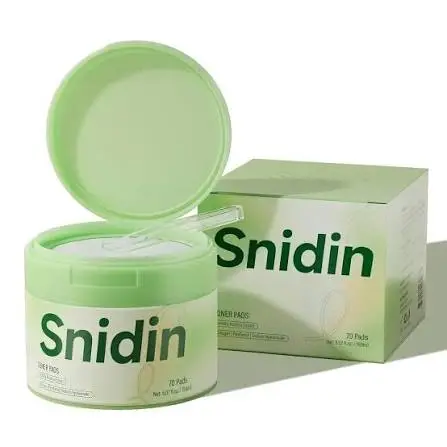
Snidin Toner Pads are essentially pre-soaked skincare pads designed to replace a separate liquid toner step. The main ingredients advertised are hyaluronic acid, Centella Asiatica extract, collagen and vitamin B5. Snidin says the formula provides deep hydration, helps soothe dry or irritated-looking skin, improves redness and blotchiness, and can help with acne marks, uneven skin tone and dullness. The company also says the pads can make the skin look more plump and radiant with consistent use.
I actually like this type of product because it is convenient. There is no toner bottle to spill, no cotton rounds sitting around the bathroom and no guessing how much product to pour into your hands. The Snidin jar comes with tweezers too, so you can pull out a pad without constantly putting your fingers into the container. The company recommends either wiping the skin with a pad or using the pad like a mini sheet mask for five minutes.
The ingredient list itself did not strike me as particularly strange. Centella is widely used in skincare products aimed at soothing the skin, while hyaluronic acid is a common humectant used to increase hydration. Panthenol, also known as vitamin B5, is another familiar skincare ingredient. Collagen is where I would be more careful with expectations because seeing collagen listed in a topical skincare product does not automatically mean that the product will rebuild collagen in the deeper layers of the skin.
How Did the Snidin Toner Pads Feel on My Skin?
What I liked most about the pads was the convenience. They are already saturated, so I could take one out and apply it without making the bathroom counter look like I was preparing for a chemistry experiment. The pad format also makes it easy to concentrate the product on areas that feel particularly dry instead of putting toner everywhere and hoping for the best.
The five-minute mask idea is probably the feature I would use most when my skin feels dehydrated. Rather than throwing another complicated serum into my routine, I can leave the soaked pads on for a few minutes and then carry on with moisturizer. Snidin specifically recommends this method on the product page.
I would not, however, buy these expecting an overnight transformation in acne marks or wrinkles. The more realistic reason to use a product like this is hydration and making the skin feel comfortable after cleansing. Even Snidin’s own instructions describe longer-term use for the more visible results, with the page saying that consistent use for two to four weeks is recommended.
There are also some mixed experiences in marketplace reviews. Current TikTok Shop feedback includes buyers who say they like the product, but one recent purchaser said the pads left a film on the skin and made their skin feel dry. That is a good reminder that even a product advertised as suitable for all skin types will not necessarily feel the same on everyone’s face.
Snidin Toner Pads Ingredients: Centella, Collagen, Hyaluronic Acid and B5
The ingredient combination is probably the strongest part of the product description. Centella Asiatica is commonly used in calming skincare, and hyaluronic acid is well known for helping the skin hold onto water. Panthenol can also be useful in moisturizing formulations, particularly when the goal is to support a comfortable skin barrier.
The collagen claim needs a little more context. Snidin says it uses “collagen water” and describes this as absorbing faster than collagen extract, while also claiming that it helps with elasticity and plumpness. I would treat that as a cosmetic marketing claim rather than assume the pads can replace treatments that actually stimulate collagen production.
This is something I think gets lost when reading skincare advertisements. A product can contain good, familiar ingredients and still be marketed with exaggerated expectations. I am much more interested in whether a toner makes my skin feel hydrated and comfortable than whether the packaging promises to reverse every sign of aging.
What About the “US FDA Certified” Claim?
This was one of the claims that made me stop and look more closely.
Snidin’s product page says the toner pads are “certified by the US Food and Drug Administration,” and the same wording appears in its specifications and FAQ. The problem is that this wording can give shoppers the impression that the FDA has tested and approved the actual toner pads.
That is not how FDA regulation of ordinary cosmetics works. The FDA explains that it does not have the legal authority to approve cosmetic products and cosmetic ingredients before they go onto the market, apart from certain color additives. Manufacturers and distributors are responsible for ensuring their cosmetic products are safe when used as directed.
So I would not use the phrase “US FDA Certified” as proof that Snidin Toner Pads have been FDA-approved or independently validated by the FDA. The wording on the Snidin website needs considerably more explanation than the page currently provides.
What About the Clinical Testing and Dermatologist Claims?
This was another part of the website that I wanted to understand before taking the product claims at face value. Snidin says the toner pads are “clinically tested” and were developed by board-certified dermatologists. The page also contains a section headed “BOARD-CERTIFIED DERMATOLOGIST AT SKINCARE RESEARCH INSTITUTE.”
What I did not find on the product page was the sort of information I would normally want if I were being asked to treat a clinical-testing claim as meaningful evidence: the name of the dermatologist, the name of the research organization, the testing protocol, where the testing was conducted, the number of participants and a published report showing the actual results.
That does not automatically prove that no testing took place. It simply means the website does not give shoppers enough information to independently evaluate the claim. Another recent review of Snidin’s website reached a similar conclusion, noting that the pages make the “clinically tested” and board-certified dermatologist claims without providing a named dermatologist, published study, study registration, testing protocol or independent clinical report.
For me, that means I would treat the clinical-testing language as a claim made by the seller rather than proof that the toner pads have been clinically demonstrated to produce all of the advertised results.
The 1,884-User Survey Claim
The numbers on the Snidin website are impressive at first glance. The company says its claims are based on surveys of Amazon and TikTok users and says the results came from 1,884 users between December 2025 and February 2026. It reports that 92% felt their skin became more hydrated and plumped, 95% reported effective hydration and deep moisturizing, 85% reported improvement in dryness and elasticity, and 96% considered the ingredients gentle and non-irritating.
I would not automatically treat those numbers as the same thing as a clinical study. A customer survey can tell us what people reported experiencing, but it does not establish that the product caused the changes or that the participants were selected in a way that represents all Snidin customers.
There is also a difference between saying “95% of surveyed customers reported effective hydration” and demonstrating through controlled testing that the product objectively increased skin hydration by a measured amount. The Snidin page gives the survey percentages but does not provide the underlying survey methodology, questionnaire, participant selection process or complete results.
Does Snidin Really Sell 2,000+ Units a Month on Amazon?
The Snidin website also says it is selling more than 2,000 units per month on Amazon and receiving widespread customer praise. Again, that is a statement coming from the seller, so I would not treat it as independently verified sales data.
There is clearly marketplace activity around the product. For example, a current TikTok Shop listing shows the Snidin toner pads with a 4.8 rating from 32 global reviews and 694 units sold on that listing. Another TikTok Shop result currently shows hundreds of sales for the same product. Those numbers show that people are buying the pads, but they do not independently confirm Snidin’s broader Amazon sales claim.
The Website Itself Made Me More Cautious
The product page has some details that look unfinished or inconsistent for a brand asking around $38 for a jar of toner pads. For example, the page contains repeated generic benefit sections and some awkward wording in places, including directions that refer to using “1-2 tablets” rather than pads.
I also found another Snidin-branded website using the domain snidin.org that presents a different brand story and lists a Spokane, Washington address and a 509-555-0189 phone number. I would not automatically assume that every Snidin-related website is operated by the same entity, but the existence of multiple sites using the Snidin name is another reason I would check exactly which seller I was ordering from.
The official Snidin.com product page itself states that the toner pads are made in China and have a 24-month expiration period. There is nothing inherently wrong with skincare being manufactured in China, of course, but I prefer when a brand is straightforward about who manufactures the product, where the company is based and who is actually responsible for customer support.
Are Snidin Toner Pads Worth Buying?
For me, the answer comes down to what you expect them to do. If you want a convenient, pre-soaked toner pad with ingredients associated with hydration and soothing, Snidin Toner Pads make sense on paper. The format is easy, the five-minute mask option is useful, and the formula contains several familiar skincare ingredients.
Where I would lower my expectations is the bigger marketing story. I would not buy these because the website says they are “US FDA Certified,” because that wording does not mean FDA approval of a cosmetic product. I would also not assume that the 1,884-person survey proves the product is clinically effective, or that the board-certified dermatologist and clinical-testing claims have been independently established when the page does not provide enough information to check them.
The price is another thing I would think about. At about $37.59 for 70 pads directly from Snidin, you are paying for convenience as much as the ingredients themselves. There are plenty of toners and toner pads on the market, so I would want to see stronger evidence before deciding that this particular jar deserves a premium price.
What I Think Of The Snidin Toner Pads
After trying the product and then looking more closely at the claims surrounding it, I would describe Snidin Toner Pads as a hydrating skincare product with a convenient format, but a website that makes several claims I would not take at face value.
I like the basic idea of the pads. Centella, hyaluronic acid and panthenol are reasonable ingredients for a hydrating and soothing skincare routine, and the five-minute mask option makes the product more versatile than simply wiping toner across your face. There is also genuine marketplace evidence that people are buying the product and leaving positive reviews, although there are some less enthusiastic comments as well.
What I do not like is how much the website leans on phrases such as “US FDA Certified,” “clinically tested,” board-certified dermatologists and impressive customer-survey percentages without giving shoppers enough supporting documentation to properly assess those claims. The FDA itself makes clear that ordinary cosmetics are not FDA-approved before going to market, so I would certainly not use Snidin’s FDA wording as a reason to believe the product has been government-tested or approved.
Conclusion
So, are Snidin Toner Pads a scam? I would not call the actual toner pads a scam based on what I found. They are a real skincare product being sold through multiple online marketplaces, and there is enough information to identify what the product is and what ingredients it claims to contain. My concern is more with the way the product is marketed. If you buy Snidin, I would buy it because you want a pre-soaked hydrating toner pad, not because you think the FDA has certified it, a clinical trial has proven all of its claims, or a few impressive percentages guarantee what your own skin will look like.
For me, that is the sensible way to look at these Snidin Toner Pads reviews. The product itself is much less mysterious than the marketing makes it sound, and I would rather judge a toner by how it fits into my skincare routine than by a long list of impressive claims that the website does not fully document.
Check out Mansculpt wave therapy plus that I talked about earlier.