
Getting a phone call telling you that you’ve qualified for a free cruise sounds like the sort of news that could brighten an ordinary day. The caller might say you are being rewarded for a previous hotel stay or that you have been selected for a special travel promotion. They may even mention familiar hotel brands to make the offer sound connected to a company you already know. But when an offer from Orlando Promotion Center comes with unexpected charges and trouble arranging the trip, the excitement can quickly turn into frustration.
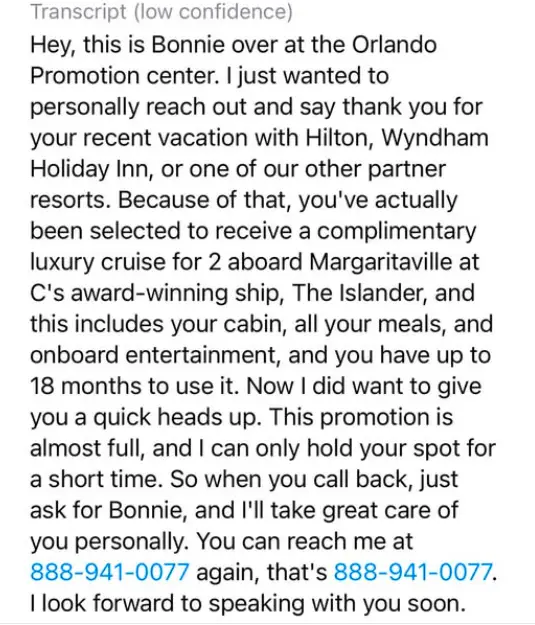
Orlando Promotion Center, also referred to as Orlando Promotion, has been mentioned in complaints and online discussions about unsolicited calls advertising complimentary cruises. Reports describe offers that may involve cruise operators such as Margaritaville at Sea, with callers presenting the trip as a reward or special promotion. The problem is that a cruise advertised as free can still leave the recipient facing substantial charges before they can book or travel. Complaints submitted to the Better Business Bureau’s Scam Tracker describe experiences involving upfront payments and difficulties getting the promised cruise arranged.
How Does the Orlando Promotion Center Cruise Offer Work?
The call may begin with a friendly explanation that you are receiving a travel reward because of a previous hotel stay, resort visit, or promotional partnership. Some reported pitches refer to well-known hospitality brands, including Wyndham, Hilton, and Holiday Inn. Hearing the name of a hotel you have actually visited can make the offer seem familiar, particularly if the caller suggests that your details came from an earlier booking or customer promotion.
However, being told that a promotion is connected to a recognizable hotel does not establish that the hotel authorized the call. It is worth contacting the hotel directly if you are unsure whether it has a relationship with the company. Do not rely on the caller’s explanation alone, especially when you never entered a competition or requested information about a cruise.
Once the caller has your attention, the conversation may focus on the cruise itself. You might hear about a complimentary sailing, a limited-time offer, or an opportunity to take a vacation without paying the usual ticket price. The offer can sound particularly attractive to someone who has wanted to go on a cruise but has put it off because of the cost. The important question is what you must pay to use the offer and whether you can actually secure the advertised trip.
Why Is a Free Cruise Coming With Hundreds of Dollars in Fees?
One of the main issues raised in complaints about these offers is the amount of money requested before a booking can be completed. Although the cruise is promoted as free, recipients may be told to pay taxes, port charges, reservation fees, or other costs. A Better Business Bureau Scam Tracker report associated with Orlando Promotion Center describes a charge of $695, illustrating how expensive a supposedly complimentary trip can become.
Cruise travel can involve legitimate taxes and port fees, so the existence of an additional charge does not automatically prove that an offer is fraudulent. What matters is whether the terms were clearly disclosed, whether the company can substantiate the offer, and whether the customer receives the service that was promised. If a caller emphasizes that you have won a free cruise but only reveals substantial mandatory costs after you have become interested, you have good reason to question the deal.
Before paying, ask for the complete terms in writing. You should be able to establish which cruise line is involved, what the payment covers, whether the amount applies to each traveler, which sailing dates are available, and whether there are additional restrictions. Find out whether airfare, accommodation before departure, onboard expenses, and other travel costs are excluded. A cruise may be advertised as complimentary while still requiring you to spend a considerable amount to take the trip.
What Happens After You Pay Orlando Promotion Center?
The booking process is another area worth examining carefully. Complaints about the offer describe difficulties reaching a satisfactory resolution after payment, including unsuccessful booking attempts and repeated explanations about missed calls or other alleged communication problems. These are customer-reported experiences rather than proof that every person who receives an offer will have the same outcome, but they raise reasonable questions about the service being sold.
Paying a fee is only the beginning if you cannot obtain a confirmed reservation. You need to know whether the payment has secured an actual cruise, whether the advertised dates are available, and what happens if the company cannot arrange the trip. A vague promise that someone will contact you later is not the same as a confirmed booking from the cruise operator.
There is also a practical issue with dealing through a third-party promotion company. The person calling you may not work for the cruise line itself, even if the offer mentions a specific operator. This means you should not assume that the cruise line has received your payment or can resolve a dispute with the promoter. Contact the cruise line through its official website and ask whether it recognizes the offer before handing over money.
Is Orlando Promotion Center a Legitimate Company?
The reports surrounding Orlando Promotion Center deserve attention, particularly where customers describe unexpected charges or difficulty obtaining the cruise they were promised. However, it is important to separate documented complaints from claims that have not been independently established. A complaint is evidence of a customer’s reported experience, not by itself a legal finding that a company has committed fraud.
What potential customers should focus on is whether the offer can be independently verified. Can the company provide clear written terms? Does the cruise operator recognize the promotion? Are the fees explained before payment? Can you confirm availability and obtain a reservation directly with the cruise line? If the caller avoids these questions, pressures you to pay immediately, or cannot explain how the promised trip will be delivered, there is little reason to proceed.
You can review reports and submit your own complaint through the Better Business Bureau Scam Tracker and report suspected deceptive practices to the Federal Trade Commission. These resources can help document consumer experiences, although neither a listing nor a complaint alone establishes a legal determination about the company.
What Should You Do If Orlando Promotion Center Calls You?
If you receive an unsolicited call offering a free cruise, take your time rather than agreeing to anything during the conversation. Ask for the company name, the full written terms, the identity of the cruise operator, and an itemized explanation of every fee. You can then verify the information independently instead of relying on a salesperson who wants you to make a decision on the spot.
Do not provide your credit card details simply because the caller says the offer will expire soon. If the promotion is genuine, you should have a reasonable opportunity to review its conditions and contact the cruise line. If the caller refuses to provide written information or insists that payment must be made immediately, end the call.
If you have already paid and cannot obtain the promised booking, keep copies of your receipts, emails, messages, and any terms you were given. Contact your credit card issuer promptly to explain what happened and ask about disputing the charge. Explain accurately whether the problem involves a service that was never delivered, a charge you did not authorize, or a refund that was not honored. The available remedies will depend on the circumstances and your card issuer’s procedures.
Conclusion
The Orlando Promotion Center free cruise offer has attracted consumer complaints involving upfront fees and problems arranging the advertised trip. That makes it worth approaching with considerable caution, especially when a caller presents an expensive vacation as a reward but expects you to pay hundreds of dollars before you can use it.
The biggest mistake would be assuming that a cruise is free simply because the caller describes it that way. Before paying, verify the promotion with the actual cruise line, read the complete conditions, and establish exactly what you will receive for your money. If the company cannot provide clear answers or you cannot independently confirm the booking, walking away is safer than risking money on a vacation you may never get to take.
Check out this Costco Scam I reviewed earlier.