
I have to admit, Microduck is not the sort of robot I expected to be reviewing. It is a small duck that walks on two legs, sits down, kicks a ball, picks up light objects with its beak and can even get back up after falling over. It is cute, certainly, but there is quite a bit of technology packed into this little machine. Developed by Pollen Robotics and Hugging Face, Microduck is designed for people who want to experiment with robotics and artificial intelligence rather than buy another ordinary electronic toy.
The $399 price is what makes it interesting. A programmable walking robot with 15 motors, cameras, sensors and open-source software would normally be expected to cost quite a bit more. However, I would not rush to place an order just because the price looks attractive. There is a long wait for current pre-orders, the battery lasts around an hour, and some of the features are really meant for people who enjoy coding and experimenting.
I went through the product information, specifications, extra packages and delivery details. I also looked at what is available from the makers and independent coverage. I have not tested a Microduck myself, so this is not a hands-on review. I want to be clear about that because the robot is still being sold through pre-orders, and I would rather tell you what is confirmed than pretend I have one sitting on my desk.
What Is Microduck Robot?
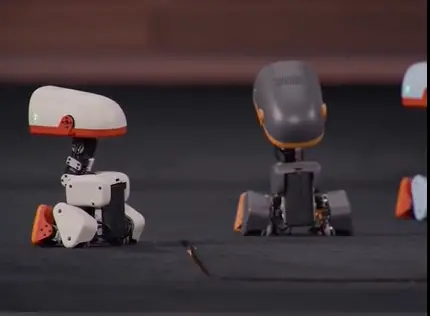
Microduck, also known as the MD-01, is a small programmable robot duck developed by Pollen Robotics, the robotics team at Hugging Face. It stands about 25 cm tall and weighs roughly 780g to 800g, so it is small enough to sit on a desk when it is not busy waddling around.
Unlike a remote-controlled toy that can only repeat a few movements, Microduck is designed to let owners work with its software and teach it new behaviours. It comes with seven trained movements, including walking, sitting, standing, turning, kicking, grabbing and getting back up after a fall. You can use the included game controller to operate it without writing any code, which is good news for people who want to play with it before getting into the more technical side.
The interesting part is that Pollen Robotics has made the software available for developers to explore and change. You can train new movements in a computer simulation and then transfer the trained behaviour to the physical duck. This is known as reinforcement learning, and it is one of the main reasons Microduck is getting attention from people interested in robotics and physical AI.
So, while the duck looks like a fun little companion, I would not describe it as a robot designed to help around the house. Its real purpose is to give people a small, physical robot they can experiment with, programme and teach new tricks.
Microduck Features and Specifications
There is more going on inside Microduck than its small size suggests. It has 15 motors spread across its legs, head and neck, allowing it to balance and perform different movements. It also has a front-facing camera, a compact depth sensor, two motion sensors called IMUs, microphones and a speaker.
The depth sensor helps it understand its surroundings, while the motion sensors help the robot keep track of its position and movement. The beak is also more than just decoration. It is an articulated gripper that can pick up lightweight objects, with the advertised capacity around 100g. That is not enough to lift anything heavy, but it gives developers another way to experiment with physical interaction.
Here is a closer look at the main specifications:
| Feature | Microduck specification |
|---|---|
| Height | 25 cm |
| Weight | Approximately 780–800g |
| Motors | 15 |
| Camera | Front-facing camera |
| Depth sensing | 8 × 8 time-of-flight sensor |
| Motion sensors | 2 IMUs |
| Processor | Rockchip RK3566 with AI accelerator |
| Memory | 1GB RAM and 32GB storage |
| Connectivity | Wi-Fi and Bluetooth |
| Beak | Articulated gripper |
| Battery | Removable 2,600mAh battery |
| Battery life | Around 1 hour, depending on use |
| Control | Included game controller |
The robot also has NFC antennas in its head and beak, along with microphones and a speaker. One thing I found interesting is that Microduck does not speak like a normal voice assistant. It makes little sounds rather than holding conversations with you. Its main attraction is movement and learning, not answering questions or acting like a smart speaker.
The makers also say it can use optional roller attachments to skate. That is a fun addition, although I would not buy the robot just because of a demonstration showing it rolling around. The more interesting feature is the ability to change and train its movements yourself.
How Does Microduck Learn New Tricks?
This is probably the most important part of the product, and it is what separates Microduck from a normal remote-controlled robot.
Pollen Robotics uses a process called reinforcement learning. Rather than programming every movement by hand, you can train a behaviour in a virtual environment where the robot learns how to move and respond to different situations. Once the behaviour has been trained and tested, it can be transferred to the real Microduck.
For example, you could work on a new walking style, adjust how the duck balances or experiment with a movement that is not included in the original seven behaviours. You can then test the result on the physical robot and make further changes if needed.
The software, simulator and reinforcement-learning tools are available as open-source projects. This means developers can inspect the code, make changes and share their work with other people. It is a nice idea because you are not limited to whatever movements the manufacturer decides to include.
However, I would not assume that every buyer will find this easy. If you have never worked with Python, robotics or machine-learning tools, there may be a learning curve. The controller makes it possible to play with the robot without coding, but getting into the training side is a different matter.
One other detail worth mentioning is that open-source does not mean the entire physical robot is open-source. Pollen’s press kit explains that the open-source part covers the software, not the mechanical and electronic design files. I think that is worth knowing because the phrase can easily give buyers the wrong impression.
How Much Does Microduck Cost?
The advertised starting price is $399 in the United States, before taxes and shipping. The European store lists it at €340. You do not have to buy any of the extra packages to use the robot because the basic order already includes the duck, battery, USB-C cable and game controller.
There are three optional packages for people who want additional equipment.
| Package | US price | What you get |
|---|---|---|
| Microduck | $399 | Robot, battery, USB-C cable and game controller |
| Charger pack | $39 | Dual charger and two extra batteries |
| Accessory pack | $39 | Laser pointer, NFC items, two roller attachments, ball and extra NFC tags |
| Developer pack | $119 | Spare motors, cables, extra batteries, charger, NFC tags, tools and Hugging Face credit |
The charger pack makes sense if you expect to spend a lot of time playing with the robot because the standard battery only lasts around an hour. The accessory pack is more for people who want to try the extra activities, while the developer pack is aimed at people who plan to work on the robot and may need spare parts.
You can start with the $399 robot and decide later whether you need the extras. I would not spend another $119 on the developer pack unless I actually planned to experiment with the hardware.
Remember that the advertised price is not necessarily the final amount you will pay. Taxes and shipping are calculated separately, so check the checkout total before placing an order.
The Biggest Problem: Microduck Is Not Shipping Soon for New Orders
This is the part I would pay close attention to before ordering.
When Microduck was first announced in August 2026, the company was targeting first deliveries before Christmas 2026. That created quite a bit of excitement, especially among people who wanted to buy one as a Christmas present.
However, demand appears to have been much higher than expected. After the robot attracted attention during Nvidia’s GTC Berlin keynote, pre-orders reportedly passed 20,000. The increased demand has affected the delivery schedule.
The later notice on the product listing says that current pre-orders should expect to ship after April 2027, with orders being fulfilled in the order they were placed. This means someone ordering now should not expect to receive the robot for Christmas 2026.
I also noticed something that buyers should not ignore. The newer product-page notice gives the after-April 2027 estimate, but Pollen’s terms of sale still list first deliveries as targeted before Christmas 2026. Those two pieces of information do not agree. The product-page notice appears to be the later update, but I would want written confirmation of the expected delivery window before paying.
This is not a small detail when you are spending $399 on something you will not receive immediately. If you are happy to wait because you want the robot for a project or hobby, that may be fine. But if you are ordering it for a birthday or Christmas, I would not take the earlier delivery promise at face value.
Is the One-Hour Battery Life Enough?
Another thing I would consider is the battery. Microduck uses a removable 2,600mAh battery, and the advertised operating time is around one hour, depending on what the robot is doing.
For a small experimental robot, that may be understandable, but it is still quite short. You could easily spend that time testing movements, trying the controller and experimenting with different behaviours. Once the battery runs down, you will need to recharge before continuing.
This is why the optional charger pack may be useful. It costs another $39 and includes a dual charger and two additional batteries. It is not essential, but anyone planning longer sessions may find it worthwhile.
I would have preferred a longer battery life at this price, particularly for people who want to use the robot regularly. Still, the removable battery is a practical choice because you can swap it rather than waiting for the whole robot to charge.
Is Microduck a Toy for Children?
I can see why parents might look at Microduck and think it would make an unusual gift. It is a little duck that walks, moves its head, picks things up and can be controlled with a gamepad. It certainly looks more entertaining than some of the ordinary toys on the market.
But I would not buy it without understanding what it is designed for. Pollen Robotics describes its products as development and experimentation platforms, recommends them for users aged 16 and above, and says they are not children’s toys. This is an important point, especially if you are considering it for a younger child.
The robot is better suited to older students, programmers, robotics enthusiasts and people who enjoy building and testing things. A younger child might enjoy watching it walk around, but the real value is in the technology behind it.
Watch Out for Fake Microduck Websites
There is another thing I noticed while looking into this product. Websites using very similar Microduck names are already appearing online, and some listings can easily be confused with the real robot.
I would not assume that a website is genuine simply because it has Microduck in its name or uses pictures of the robot. The actual product is developed by Pollen Robotics, and its official website links directly to the store at store.pollen-robotics.com.
If you want to order, start from Pollen Robotics’ official Microduck page and follow its pre-order link. Avoid unfamiliar websites offering a cheaper price, guaranteed Christmas delivery or a different version of the robot. I would also be suspicious of listings on marketplaces that claim to have Microduck available for immediate delivery when the official store is still dealing with a long pre-order queue.
Is Microduck Worth the $399?
I think Microduck is an interesting product, and I can understand why people are excited about it. You are getting a small biped robot with 15 motors, several sensors, a camera, an articulated beak and software that allows you to train new movements. The open-source approach is also a big advantage for people who want to learn rather than simply use whatever features come in the box.
But I would separate the excitement around the robot from the decision to spend $399 on it. If you are a programmer, robotics student or someone who enjoys experimenting with AI, I can see the appeal. You get a physical platform to work with, and the ability to train new behaviours gives it more long-term interest than a robot that only performs a fixed set of tricks.
For everyone else, I would probably wait. The battery life is short, the robot is not designed to perform useful household tasks, and current pre-orders are not expected to ship until after April 2027. That is a long time to wait for something you may eventually find entertaining for only a few days.
I would also like to see more independent owners using the finished product before making a stronger recommendation. The demonstrations are interesting, but they do not tell us everything about how the robot will perform after weeks or months of normal use.
A Promising Robot, But I Would Not Rush to Pre-Order
My verdict on Microduck is a cautious yes, but mainly for people who understand what they are buying. I like the idea of a small robot that you can programme, train and experiment with, and $399 is an interesting starting price for this kind of platform.
However, I would not recommend it as an ordinary household robot or a last-minute gift. It is more of a robotics project that happens to look like a duck, and buyers who are not interested in coding or experimenting may not get much out of it beyond the novelty.
The delivery delay is also something I would take seriously. With current orders expected to ship after April 2027, there is no reason to rush into a purchase because of the Christmas excitement surrounding the launch.
I would consider Microduck worth the money for someone who genuinely wants to learn robotics and play with open-source AI. For everyone else, I would wait until more units have reached customers and we have a better idea of how well the finished robot performs.
Check out Necklow Sleep Pillow that I reviewed, earlier.