
Paratoxil is being marketed as a daily gut cleanse supplement containing psyllium husk, slippery elm, ginger, chlorella and black walnut hull. The sales pitch focuses heavily on digestive wellness, gut cleansing and getting rid of unwanted buildup, while some of the marketing goes further by talking about microbial balance and internal cleansing.
At first glance, Paratoxil looks like a fairly typical herbal supplement. It comes in capsule form, is marketed as a 30-day supply, and the official product information says that two capsules should be taken with water. But once you look beyond the sales page, there are a few things worth paying attention to, particularly the way the product is advertised online, the stronger claims associated with parasite cleansing, and the mixed customer feedback surrounding the company selling it.
There is also something unusual about the product pictures being used online. Many of the images presented for Paratoxil appear to be AI-generated rather than straightforward photographs of the actual product. That matters because realistic-looking AI images can make an unfamiliar supplement appear more established or professionally presented than it may actually be. They can also make it difficult for shoppers to know what the real bottle, capsules, packaging and physical product actually look like.
That does not automatically prove that Paratoxil is fake. However, when a supplement is being sold almost entirely through online marketing, I think buyers should be able to see genuine photographs of the product rather than relying heavily on artificial promotional imagery.
What Is Paratoxil?
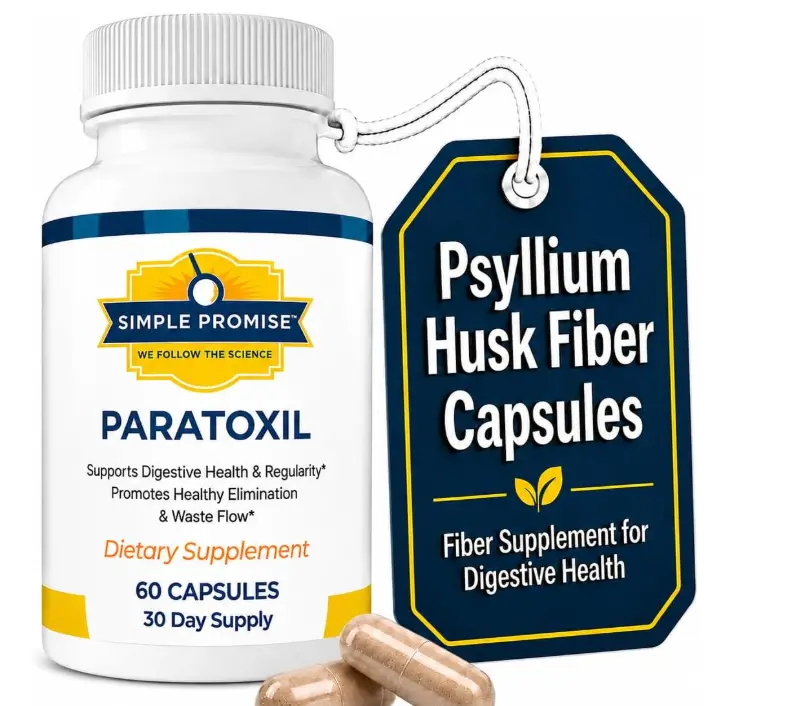
Paratoxil is sold as a plant-based gut wellness supplement. The official website describes it as a fiber-led formula rather than an overnight laxative or drug, and the product contains 60 capsules, which is advertised as a 30-day supply.
The main ingredient is psyllium husk. According to the manufacturer’s current ingredient information, two capsules provide 1,080 mg of psyllium husk. The formula also lists slippery elm, cape aloe, chlorella and ginger, along with a proprietary blend containing black walnut hull, hyssop, papaya, inulin, acai and lycopene.
The proprietary blend is worth noticing because the individual amounts of those ingredients aren’t disclosed. So although the label tells you what is included, you cannot see exactly how much black walnut hull, hyssop or the other ingredients you’re getting from that part of the formula.
The official website also specifically says that Paratoxil is not an anti-parasitic medication and is not intended to diagnose, treat, cure or prevent disease. That is considerably more restrained than some of the language used in online marketing surrounding gut cleanses and parasite products.
What Does Paratoxil Claim to Do?
The basic idea behind Paratoxil is easier to understand than some of the more dramatic claims surrounding it. Psyllium is a source of fiber, and the company presents the formula as something intended to support regular digestion and general gut wellness.
The problem comes when consumers see words such as “cleanse,” “detox,” “parasite,” “microbial balance” and “internal cleanse” and start interpreting them as proof that the capsules can remove parasites or treat an infection.
Those are very different claims.
A fiber supplement can provide dietary fiber without being a treatment for a parasitic infection. Likewise, including herbs traditionally associated with cleansing does not establish that the finished product can eliminate parasites from the human body.
The company’s own website actually acknowledges this by telling people who suspect they have a parasite or medical condition to speak with a licensed healthcare professional.
That is an important distinction for anyone considering Paratoxil because the strongest expectations surrounding a product like this can come from the advertising rather than from established evidence about the finished supplement.
The AI Product Pictures Are Worth Noticing
One of the things that stood out to me when looking at Paratoxil online is the imagery.
Rather than relying consistently on ordinary product photography, the online presentation includes images that appear to have been generated or heavily enhanced using AI. The pictures can make the supplement look extremely polished and professionally staged, but they don’t necessarily show shoppers what they will actually receive.
This is becoming increasingly common with online supplement advertising. AI-generated pictures can create a bottle, capsules, ingredients and lifestyle scenes that look completely realistic without necessarily representing an actual photograph of the product.
That doesn’t by itself mean the supplement inside the bottle is fake. But it does make the marketing harder to evaluate.
When I’m looking at an unfamiliar supplement, I want to see clear photographs of the actual bottle, the label, the capsules and preferably the manufacturer or production facility. Those types of photographs give a buyer something concrete to compare with the package that eventually arrives.
With Paratoxil, the polished AI-style imagery makes the marketing look more convincing, but it doesn’t provide the same level of reassurance as genuine product photography.
How Much Does Paratoxil Cost?
The price depends on which website you’re buying from.
The current Paratoxil website lists a one-bottle purchase at $69, with lower per-bottle pricing for larger quantities. It advertises three bottles for $177 and six bottles for $294. The site says the product comes with a 365-day money-back guarantee.
There is another sales website, Simple Promise, that currently lists Paratoxil at different prices and also presents subscription options. That is something buyers should pay attention to before completing checkout.
The difference between a one-time purchase and a subscription can be significant with supplements because consumers sometimes assume they are placing a normal one-off order and later discover that they agreed to recurring shipments.
If you do purchase it, read the checkout page carefully and make sure you know whether the order is one-time or recurring before entering your payment details.
What About the Paratoxil Ingredients?
The ingredient list is not particularly mysterious.
Psyllium husk makes up the largest disclosed portion of the formula, at 1,080 mg per two-capsule serving. Slippery elm, cape aloe, chlorella and ginger are also individually listed at 50 mg each.
Then there is the 250 mg proprietary blend containing black walnut hull, hyssop, papaya, inulin, acai and lycopene.
The use of a proprietary blend doesn’t automatically make a supplement bad, but it limits transparency because you cannot tell how much of each ingredient is actually present.
For someone specifically buying Paratoxil because of the black walnut or another ingredient, that is useful information to know before spending money.
The company also says the formula does not contain senna, cascara or caffeine and describes it as a non-stimulant, fiber-based approach rather than a harsh laxative.
Does Paratoxil Really Remove Parasites?
This is where I would be particularly careful with the marketing.
There is a huge difference between supporting normal digestion and treating an actual parasitic infection. A person who has a parasite does not necessarily know that simply from digestive symptoms such as bloating, constipation or changes in bowel habits.
The CDC explains that diagnosing parasitic infections can involve appropriate testing based on symptoms and medical history, and that stool testing may sometimes require multiple samples collected on separate days.
That is very different from simply taking a supplement and assuming that anything appearing in the toilet afterward represents parasites being removed.
Paratoxil’s official website does not claim to be an anti-parasitic drug, and it tells consumers with suspected medical conditions to seek professional advice. So I would not treat the supplement as a substitute for diagnosis or treatment.
What Are Customers Saying?
There is another issue with the “Paratoxil Trustpilot rating” that is easy to misunderstand.
Paratoxil does not currently have a straightforward Trustpilot profile that I would use to say, “Paratoxil has a 4.2 out of 5 Trustpilot rating.” The Trustpilot information associated with the seller is primarily connected with Simple Promise, the company behind several products, rather than being a clean Paratoxil-only review score.
The current U.S. Simple Promise Trustpilot profile shows a mixed customer history, with both positive and negative reviews. Some customers describe receiving help with cancellations or refunds, while other reviewers have complained about issues involving orders, refunds, shipping costs or advertising.
There are also reviews concerning other Simple Promise products, so it would be misleading to take every company-level complaint and present it as a complaint specifically about Paratoxil.
On the other hand, it would also be misleading to use the company’s overall Trustpilot score as proof that Paratoxil itself has been independently validated.
There is a separate retail listing for Paratoxil that shows a 4.2/5 rating from hundreds of customer reviews, but that is a retailer’s customer-review rating rather than evidence that the supplement has been clinically proven to work.
So when you see a number such as “4.2/5,” it’s important to ask what exactly is being rated: the product, the retailer, the company or a completely different set of products.
Is Paratoxil FDA Approved?
No dietary supplement should be presented as though it has gone through the same approval process as an FDA-approved prescription or over-the-counter drug.
The FDA explains that it does not routinely approve dietary supplements for safety and effectiveness before they are sold. Supplements also cannot legally be marketed as products intended to diagnose, treat, cure or prevent disease without falling under drug regulations.
Paratoxil’s own website includes the standard disclaimer stating that its statements have not been evaluated by the FDA and that the product is not intended to diagnose, treat, cure or prevent disease.
So if you see advertisements suggesting that Paratoxil can treat a medical condition, eliminate an infection or perform a medically established “detox,” don’t confuse that advertising language with FDA approval.
Are There Any Side Effects?
The company says that temporary gas or fullness can occur, which is not surprising with a fiber-containing product.
It also warns that black walnut hull is a tree nut and therefore may be unsuitable for people with nut allergies. The manufacturer advises pregnant or breastfeeding women, people taking prescription medication and people with digestive conditions to consult a healthcare professional before using it.
The website also warns that psyllium may affect the absorption of some medications and recommends separating it from prescription medicines.
Those warnings are worth taking seriously. A supplement being made from plants does not automatically mean it is suitable for everyone.
So, Is Paratoxil a Scam?
Based on the information available, I wouldn’t describe Paratoxil itself as an obvious fake supplement. There is a real product being marketed under the Paratoxil name, the ingredient list is published, and the company provides purchasing and refund information.
What makes me more cautious is the way the product is marketed.
The AI-generated or AI-enhanced product imagery makes it harder to judge the physical product from the advertising alone. The different sales pages also use somewhat different pricing and purchasing arrangements. And the broader marketing around gut cleansing and microbial balance can easily lead consumers to expect something much stronger than ordinary digestive support.
Most importantly, a supplement containing psyllium, herbs and other botanical ingredients should not automatically be treated as a proven treatment for parasites or infections.
Conclusion
So my view of Paratoxil is fairly simple: it appears to be a real dietary supplement, but I would be skeptical of any advertising that makes it sound like a medically proven parasite treatment or a powerful detox product. The AI-style product images are another reason I would want to see more genuine product photography and independent evidence before putting much weight on the marketing.
If you’re considering buying it, look closely at the actual ingredient amounts, whether you’re placing a one-time or subscription order, the refund terms, and what you’re realistically expecting the capsules to accomplish. If you genuinely suspect a parasite or other digestive illness, getting the condition properly evaluated makes much more sense than trying to diagnose it from online supplement advertising.
Check out Mansculpt wave therapy plus that I talked about earlier.