
The QuickBooks Online Accountant Invitation scam is a phishing email currently making the rounds while pretending to come from Intuit QuickBooks. The message tells recipients that someone identified as “Payroll” has invited them to join a QuickBooks Online Accountant account, and at first glance it looks surprisingly convincing. It uses the QuickBooks name and branding, talks about accountant access and client accounts, and gives the recipient an “Accept Invitation” button that looks like a normal QuickBooks invitation.
That is exactly what makes this scam worth talking about. Someone who works with accounting, payroll or small-business finances may not think twice about receiving an invitation like this, particularly if they have used QuickBooks before or deal with several businesses and accounting firms. The email doesn’t need to look ridiculous to work. It only needs to look familiar enough that the recipient clicks before checking where the button actually goes.
I came across the details of this particular campaign and, yes, the QuickBooks Online Accountant invitation email is fake. It is not simply an unusual QuickBooks notification or a genuine accountant invitation sent to the wrong person. The campaign has been identified as a phishing scam designed to get people onto a fraudulent website and ultimately steal their login information.
What is the QuickBooks Online Accountant Invitation email scam?
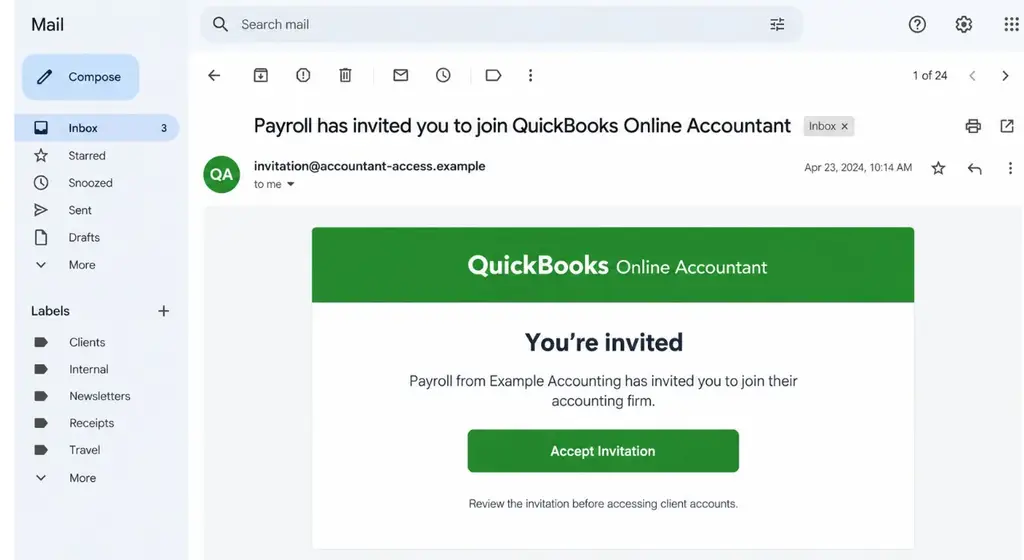
The email uses a subject along the lines of “Payroll has invited you to join QuickBooks Online Accountant as a new user.” Inside, it claims that “Payroll” from an accounting firm has invited the recipient to join QuickBooks Online Accountant. It then explains that accepting the invitation would give the new user access to the firm’s clients and accounting tools.
There is nothing inherently strange about receiving an invitation to QuickBooks Online Accountant. Real QuickBooks users can invite accountants and other users, and Intuit’s own documentation confirms that legitimate invitations are sent by email. A genuine accountant invitation can allow an accountant to connect with a client’s QuickBooks company and work with its books.
That is why this particular scam has a reasonable chance of fooling people. The criminals are not inventing some completely unfamiliar service. They are taking an ordinary QuickBooks feature and putting a fraudulent website behind it.
The fake email contains an Accept Invitation button and other links that are made to look like part of the QuickBooks service. According to the current analysis of the campaign, clicking the invitation does not take the victim to QuickBooks. Instead, it redirects to a website at humanandairesources[.]com, which has no legitimate connection to Intuit or QuickBooks.
The fake Adobe login page is where things get ugly
The phishing page doesn’t necessarily scream “QuickBooks scam” once you arrive there. Instead, the page reportedly displays a pop-up designed to look like an Adobe document security or verification service. The visitor is told that a document is protected and needs to be accessed by signing in.
That is a clever little trick because the person has already been told they were invited to an accounting service. Seeing what appears to be a protected business document may seem perfectly reasonable. The page asks for an email address and password, with the email address potentially already filled in.
But there is no legitimate reason for a random QuickBooks accountant invitation to send you to an unrelated domain and then ask you to enter your credentials into a fake document-verification page. The purpose is to collect the information you type into it.
This is a credential phishing scam, not a genuine QuickBooks Accountant invitation.
How the QuickBooks payroll scam works
The basic setup is fairly simple. You receive an email that appears to be connected with QuickBooks and says that “Payroll” has invited you to join an accounting firm. You click Accept Invitation, expecting to be taken to QuickBooks. Instead, you are redirected to a fraudulent website.
The fake site then gives you another reason to enter your email address and password. If you do so, the scammers potentially have credentials that could be useful beyond this particular website. If the victim has reused the same password elsewhere, the damage can extend well beyond the original phishing page.
This is one reason I would take this particular email seriously even if you don’t actually use QuickBooks Online Accountant. A phishing campaign does not need you to be a QuickBooks customer to be dangerous. The whole point is to get you to believe the message long enough to hand over information.
How to tell if a QuickBooks Accountant invitation is fake
The sender address is one of the first things I would check, but I would not stop there. Intuit says its official email addresses end in @intuit.com, and links in legitimate Intuit emails should lead to Intuit-owned domains such as quickbooks.intuit.com or other official Intuit domains. Intuit specifically warns users to be suspicious of slightly altered domains that are designed to look legitimate.
That matters here because the scam does not rely on the QuickBooks logo alone. The destination of the Accept Invitation button is the bigger giveaway. A message can look completely professional while the link underneath takes you somewhere else.
If you receive an unexpected QuickBooks accountant invitation, hover over the button before clicking it and look at the actual destination. If it points to an unfamiliar domain, especially one that has nothing to do with Intuit, don’t open it.
Also ask yourself a very basic question: Was I actually expecting an invitation? If you have no accountant, payroll provider or accounting firm that should be inviting you to QuickBooks Online Accountant, there is little reason to accept the message simply because it has the QuickBooks logo on it.
And if you already use QuickBooks, don’t use the email as your way of checking whether the invitation is real. Open your browser and go directly to the official QuickBooks website instead. Intuit itself recommends accessing your account directly rather than following suspicious email links.
But real QuickBooks invitations do exist
This is worth mentioning because otherwise someone reading this could become suspicious of every QuickBooks invitation they receive.
QuickBooks Online Accountant invitations are a real feature. Clients can invite accountants to connect to their QuickBooks Online company, and Intuit provides instructions for accepting those invitations. Intuit also says an invitation can expire after 30 days, so receiving an invitation by email isn’t unusual by itself.
The problem with the scam is what happens after the recipient clicks the invitation. A legitimate QuickBooks workflow should lead back into the Intuit/QuickBooks environment and allow the user to sign in with their existing Intuit credentials. It should not suddenly send them to an unrelated website pretending to be an Adobe security or document service.
That is the part that gives this scam away.
What happens if you clicked the fake QuickBooks invitation?
If you only opened the email and did not click anything, there is generally no reason to panic. Delete it and report it as phishing.
If you clicked the link but did not enter your password or download anything, close the fraudulent page and avoid interacting with it further. It would still be sensible to run a security check on your device, particularly if the page attempted to download something.
If you entered your QuickBooks or Intuit password into the fake page, however, I would treat the account as potentially compromised. Change your password by going directly to the official Intuit website rather than using a link from the email. If that password is used anywhere else, change it there as well.
Intuit recommends reporting suspected phishing emails that misuse its brand by forwarding them to [email protected] and deleting the message.
Conclusion
The QuickBooks Online Accountant Invitation email scam is a genuine phishing campaign, and the fake “Payroll” invitation is simply the bait. The email looks convincing because it is built around something that really exists: QuickBooks Online Accountant invitations. That familiarity is what makes the scam more believable than many of the poorly written phishing emails that land in spam folders.
The giveaway is the destination behind the invitation. In this campaign, the link leads away from Intuit to a fraudulent website and ultimately presents a fake login prompt designed to capture credentials.
So if an unexpected email lands in your inbox saying “Payroll has invited you to join QuickBooks Online Accountant,” don’t accept it just because it looks like QuickBooks. Check the sender, inspect the link, and, most importantly, access QuickBooks directly rather than through the email.
For anyone searching “QuickBooks Online Accountant invitation scam,” the answer for this particular campaign is straightforward: it is a phishing scam, and the invitation should not be accepted.
Check out Mansculpt wave therapy plus that I talked about earlier.