
I came across TrueForm Fascial Release while looking into supplements being marketed for stiffness, mobility and everyday body discomfort, and I’ll admit the idea caught my attention. Instead of the usual joint supplement pitch, TryFascial.com takes a different approach and says that the real problem may be the fascia, the connective tissue surrounding and running between structures throughout the body. The company says its TrueForm capsules are designed to support healthier, more hydrated fascia and, as a result, make movement easier and reduce stiffness.
It sounds convincing when you read through the sales page, especially because the website goes much further than simply saying the capsules support connective tissue. It talks about “restricted” or dehydrated fascia, chronic pain, nerve symptoms, mobility problems and whole-body relief. There is even a reference to 2026 research and claims about people experiencing significant improvements after taking the product. That made me want to look past the sales pitch and see how much of this is actually supported.
I also found something more concerning while researching TryFascial.com reviews: a BBB Scam Tracker complaint filed in June 2026 by a customer who said they attempted to cancel an order shortly after placing it but were told it had already shipped. The person reported losing $122.92 and identified TryFascial.com and Fascial/Trueform in the complaint. A BBB Scam Tracker report represents the customer’s account of what happened, so I wouldn’t treat that one report as proof that TryFascial is fraudulent, but it is certainly relevant when you’re deciding whether to place an order.
What Is TrueForm Fascial Release?
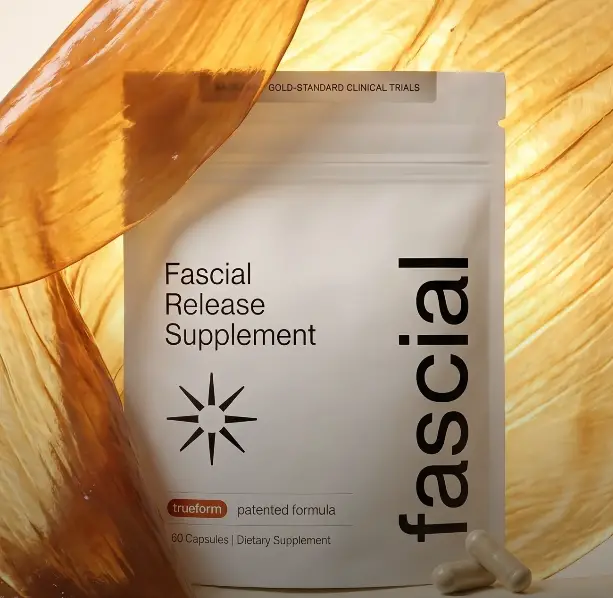
TrueForm Fascial Release is a daily capsule sold through TryFascial.com. The recommended serving is two capsules per day, and the current product page says a bottle contains 30 servings. The company markets it for flexibility, mobility, stiffness, body discomfort and what it describes as “fascial rehydration.”
The formula is actually more detailed than I expected. The Supplement Facts panel lists 150 mg of hyaluronic acid, 50 mg of pine bark extract standardized to 95% proanthocyanidins, 100 mg of grape seed extract standardized to 95% proanthocyanidins, 100 mg of bamboo extract, 2 mg of manganese, 40,000 SPU of serrapeptase, 130 mg of Boswellia extract standardized to 65% boswellic acids, 100 mg of Gotu Kola and 3 mg of boron. The page also lists copper in its ingredient explanations, although the displayed Supplement Facts section I found does not present the copper amount in the same table.
That gives you considerably more information than a lot of supplement websites provide. The question is whether the presence of these ingredients actually proves the much broader claims being made about fascia, chronic pain and mobility.
What Does TrueForm Claim to Do?
The main sales pitch is built around the idea that fascia can become dense, dehydrated and restricted, which the company says can contribute to stiffness, discomfort and reduced mobility. TrueForm is then presented as a way of supplying the body with ingredients that supposedly help rehydrate and loosen this tissue.
The website specifically says that hyaluronic acid draws water into the fascial matrix, while pine bark and grape seed extracts are described as protecting collagen and supporting connective tissue. Gotu kola is promoted for collagen synthesis, Boswellia for inflammatory balance and serrapeptase for breaking down accumulated protein in fascia.
This makes the product sound almost like a targeted treatment for a specific underlying problem rather than an ordinary dietary supplement. That’s where I would slow down and look at the evidence.
The fact that an ingredient has been studied for one biological effect does not automatically demonstrate that taking the ingredient in this particular combination will produce the results claimed by the manufacturer. That’s especially true when the website moves from general connective-tissue biology into claims about chronic pain, neuropathy, fibromyalgia, hypermobility and other health conditions.
The Claims About Fascia Need Some Context
There is nothing strange about fascia itself. Fascia is real connective tissue and researchers absolutely do study its role in movement, pain and musculoskeletal health. The question is whether taking TrueForm capsules can produce the wide-ranging effects promised on the sales pages.
TryFascial makes some very specific claims. One page says that 92% of people in its “first cohort” reported easier movement and less stiffness within two weeks. Another page discussing neuropathy refers to a cohort study and says that a majority of participants experienced meaningful reductions in symptoms over a 90-day period.
Those numbers sound impressive, but I would want to see the underlying study before treating them as established evidence for the product. In particular, there is a big difference between a company’s own customer cohort and a large, independently conducted randomized clinical trial published in a peer-reviewed medical journal.
The website references published research, but some of the wording on the sales pages makes it easy for a reader to come away thinking that the studies directly prove TrueForm works for all of the conditions mentioned. That is a stronger conclusion than I would make from the information available on the website.
TrueForm Ingredients: Are They Enough to Prove It Works?
This is another area where the marketing gets ahead of the evidence.
Hyaluronic acid, Boswellia, Gotu Kola, grape seed extract, pine bark and other ingredients in TrueForm have been researched individually for various purposes. That is worth acknowledging. It would be inaccurate to say the formula consists of completely unknown substances.
But the product isn’t selling one of these ingredients in isolation. It’s selling a nine-component formula and making claims about fascia, stiffness, mobility and whole-body discomfort.
For me, the important question is not simply “Have these ingredients ever been studied?” Almost any supplement ingredient can be connected to some research if you look hard enough. The more useful question is whether there is good evidence that this exact formulation, at these exact amounts, taken as directed, produces the results advertised by TryFascial.
I haven’t seen enough independent evidence to make that leap.
The Serrapeptase Claim Got My Attention
Serrapeptase is probably one of the more unusual ingredients in this formula. TrueForm provides 40,000 SPU per serving and describes serrapeptase as a proteolytic enzyme that breaks down excess protein accumulation associated with dense fascia.
That’s a strong biological story, but a biological story is still not the same thing as clinical proof that an oral supplement will “loosen” restricted fascia throughout the body.
The product’s website also talks about the enzyme being absorbed systemically and acting on compressed tissue. Those are exactly the kinds of claims I would want independently substantiated before accepting them as established fact.
So while serrapeptase makes the formula sound sophisticated, I wouldn’t take its presence as proof that TrueForm can treat chronic pain or nerve problems.
Is TryFascial.com a New Website?
The website does appear to have a very young online footprint. ScamAdviser currently describes tryfascial.com as a young site with a low traffic ranking, although its overall assessment says the site is probably legitimate rather than clearly fraudulent. It also notes that the site has a valid SSL certificate and that payment methods offering money-back services are available.
This is important because I’ve seen people automatically interpret a young domain as proof of a scam. That’s not fair. Plenty of legitimate companies launch new websites, and a young domain by itself tells me very little about whether the product is good or bad.
What it does mean is that there isn’t a long-established track record to fall back on. When a company is relatively new and is making substantial health-related claims, I personally want more independent evidence before feeling comfortable recommending it.
The BBB Scam Tracker Complaint
This is probably the most important piece of outside information I found.
A BBB Scam Tracker report dated June 13, 2026 identifies the business name as “Fascial (trueform)” and the website as TryFascial.com. According to the customer’s account, they placed an order, changed their mind less than 30 minutes later and contacted the company within the stated 24-hour period. The customer says they were nevertheless told the order had already shipped and could not be refunded. The reported amount was $122.92.
Again, this is a consumer complaint, not a court finding or government determination that TryFascial is a scam. BBB itself explains that Scam Tracker consists of reports submitted by people who say they encountered scams or potentially fraudulent activity.
Still, I wouldn’t ignore it. The complaint is directly relevant to one of the biggest issues people should understand before buying TrueForm: how the ordering, cancellation and recurring-refill system works.
Is TrueForm a Subscription?
Yes, and this is something I would read carefully before checking out.
The current TryFascial subscription policy says that orders can include automatic monthly refills, with the same pack being sent every 30 days and the payment method used for the original purchase charged automatically. The policy says customers can change or cancel their subscription, and the company says it can be managed through the account area.
The FAQ says the default purchase is one-time and that subscription is optional, with the subscription offering a 15% saving. It also says customers can cancel with one click or contact the company by email.
That means I wouldn’t describe the subscription as completely hidden. It is disclosed in the current information on the website. However, anyone ordering through an advertisement should still check the exact option selected at checkout because the price and recurring arrangement matter.
There is another detail worth knowing. The company’s contact page says that once a refill has been billed, it ships within 24 hours and cannot be cancelled or refunded. It advises customers to cancel or skip before the billing date to avoid the next charge.
That is precisely the kind of information I would want to understand before entering my card details.
What About the 90-Day Refund?
TryFascial advertises a 90-day money-back guarantee, which sounds generous at first. The current FAQ says customers should take TrueForm consistently for 90 days and, if they don’t feel a meaningful improvement, contact the company between day 90 and day 97 with a refund request. It says customers must return three empty pouches and that the product cost will be refunded.
This is slightly different from the broad wording on the product page, which simply says the product can be returned within 90 days for a full refund with “no questions asked.”
That’s something I would pay attention to. The detailed policy is what matters when you’re actually requesting a refund, so I would save a copy of the terms that apply when you place the order rather than relying on a headline guarantee.
What Does TryFascial Say About Customer Reviews?
The website claims a substantial amount of customer satisfaction. The current product page displays a 4.8/5 rating and more than 10,000 total ratings, while the homepage says that 92% of people in its first cohort reported easier movement and less stiffness within two weeks.
Those are company-displayed figures, so I wouldn’t treat them in exactly the same way as a large body of independent reviews from verified purchasers on an outside platform.
That doesn’t mean they’re fake. It simply means there is a difference between a company’s own reported results and independently verifiable customer feedback. When I’m deciding whether a new supplement is worth buying, I want to see both.
Is TrueForm Fascial Release Legit or a Scam?
After looking at the website, the product information, the subscription policy and the BBB report, I wouldn’t call TrueForm a proven scam. There is an identifiable product, a published ingredient panel, a stated refund policy, a contact email and an explicit subscription policy. The website also provides a company name, Fascial Labs LLC, in its privacy policy.
At the same time, I wouldn’t give it a clean bill of health simply because the website looks professional.
The biggest concern for me is the gap between the strength of the marketing and the amount of independent evidence supporting the product’s broad health claims. TrueForm is presented as a solution for fascia restriction, chronic stiffness, pain, neuropathy and other problems, yet much of the evidence highlighted by the company comes from its own cohort and interpretation of research rather than large independent trials of the finished product.
Then there is the BBB Scam Tracker complaint involving a reported $122.92 loss and an attempted cancellation. One complaint doesn’t establish a pattern by itself, but it is enough that I would want to understand the cancellation and refill terms before ordering.
My Take on TryFascial.com and TrueForm
TrueForm Fascial Release is more complicated than the average supplement scam story. There are enough legitimate-looking details that I wouldn’t simply label the product fake, but there are also enough unanswered questions that I wouldn’t recommend buying it solely because an advertisement promises relief from stiffness and chronic discomfort.
The ingredient list is detailed, and the company gives specific amounts for most of its ingredients. I also appreciate that the website has a dedicated subscription policy rather than hiding recurring billing completely. The 90-day guarantee gives buyers a longer period to assess the product, although the detailed refund terms should be read carefully.
Where I remain unconvinced is the leap from those ingredients to the sweeping claims about “rehydrating” fascia and relieving problems ranging from ordinary stiffness to neuropathy and chronic pain. The company may believe its formulation works, and its own reported customer data may be encouraging, but that isn’t the same as independent clinical evidence proving the product works as advertised.
So if you’re searching for TryFascial.com reviews, I would put it in the “proceed carefully” category rather than assuming either extreme. The site has real product information and a stated refund system, but it is a relatively young online business, there is a BBB Scam Tracker complaint worth knowing about, and the health claims deserve more independent evidence than the sales pages currently provide.
For me, that is the part that matters most. A supplement can have an interesting ingredient list and a very convincing website, but when the promises start moving into chronic pain, neuropathy and whole-body medical relief, I want to see solid independent evidence behind those promises before I take them seriously.
Check out Mansculpt wave therapy plus that I talked about earlier.