
I bought the Ninja HydraSense WF1001WH1 because I had reached the point where I was tired of drinking tap water that tasted and smelled heavily of chlorine. I also wasn’t particularly interested in installing a reverse osmosis system under the sink or dealing with plumbing, wastewater, and another complicated appliance. What appealed to me about the HydraSense was that it sits on the countertop, holds a decent amount of water, filters it on demand, and is supposed to remove a much wider range of contaminants than a basic pitcher while leaving naturally occurring minerals in the water. After using it for a few days, I have a much better idea of what I like about it, what I think is genuinely clever, and where I would still reserve judgment.
My First Impression of the Ninja HydraSense
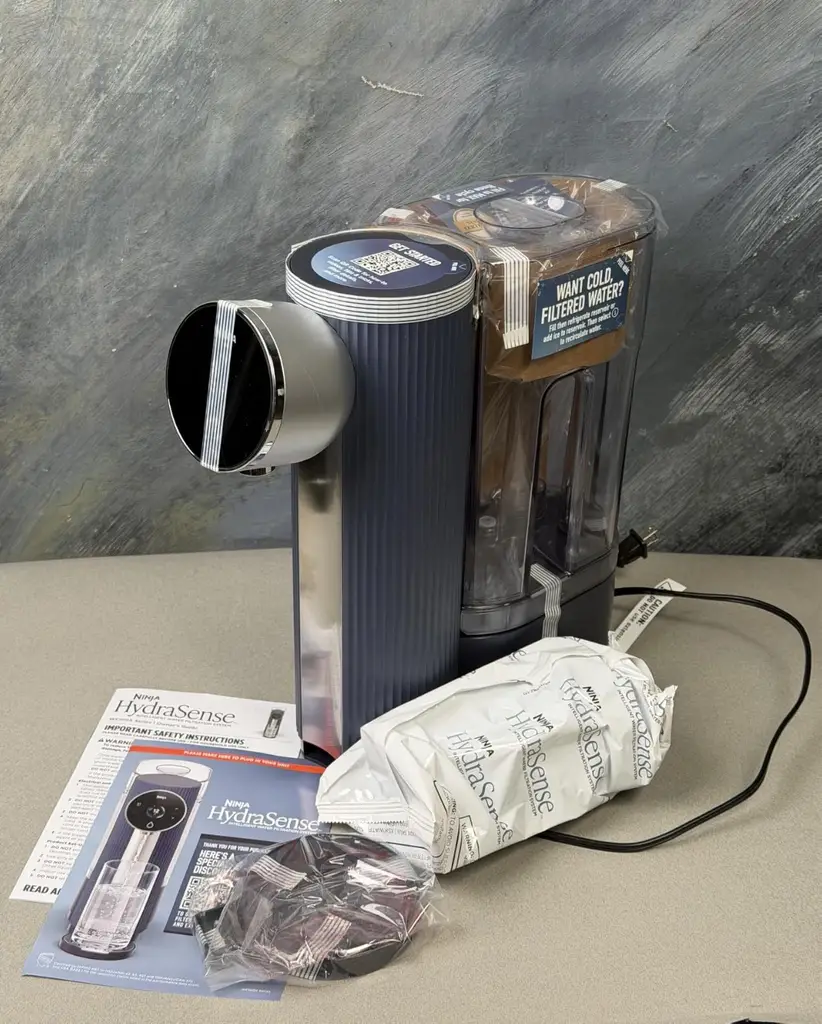
The first thing I noticed was that the Ninja HydraSense actually looks like something I would want sitting on my kitchen counter. That may sound superficial for a water filter, but when you’re buying a countertop appliance that you’re going to see and use several times a day, appearance and size do matter. The machine has a modern look, the display makes it feel considerably more sophisticated than a traditional filtered-water pitcher, and the overall setup didn’t turn into the project I was half expecting it to be.
Setup was easy. I installed the filter, filled the reservoir, attached it to the machine and followed the initial instructions. There was no plumbing to deal with and no need to connect anything underneath the sink. Once everything was in place, using it was basically a matter of filling the tank and pressing the button to dispense water. Other early users have made similar comments about the straightforward setup and simple dispensing, although there are already a few reports of leaking, so I would pay attention to that during the first few uses.
That ease of use is probably one of the biggest reasons I can see myself continuing to use the HydraSense. With some filtration systems, you eventually get tired of the process involved in getting filtered water. The HydraSense feels much more like a regular appliance: fill it, press the button and get your water.
The Biggest Difference for Me Was the Taste
I haven’t had my tap water professionally tested, so I’m not going to pretend that I can tell you exactly what was in my water before I filtered it. What I can tell you is what I noticed immediately, and for me that was the chlorine.
My tap water had an extremely strong chlorine smell and taste that I really disliked. After running it through the Ninja HydraSense, the chlorine smell was gone and the chlorine taste was completely gone as well. The filtered water still had a more subtle version of the underlying tap-water taste, but it was noticeably cleaner and much easier for me to drink.
That actually makes sense when you look at what the HydraSense is designed to do. This isn’t supposed to be a reverse osmosis system that strips virtually everything out of the water. Ninja specifically markets the filtration system around removing a broad range of contaminants while preserving naturally occurring minerals and electrolytes. So if you’re expecting that extremely neutral, almost blank taste you can get from heavily purified or zero-TDS water, that’s not really what this product is trying to deliver.
For my particular situation, that’s fine. I don’t need my drinking water to taste completely disconnected from the source. I simply wanted to take the awful chlorine taste out of my tap water, and the HydraSense has done that so far. I went from not wanting to drink my tap water to having no problem filling a glass from the HydraSense, and that is a meaningful improvement for me.
Is the Ninja HydraSense Really Faster Than a Brita?
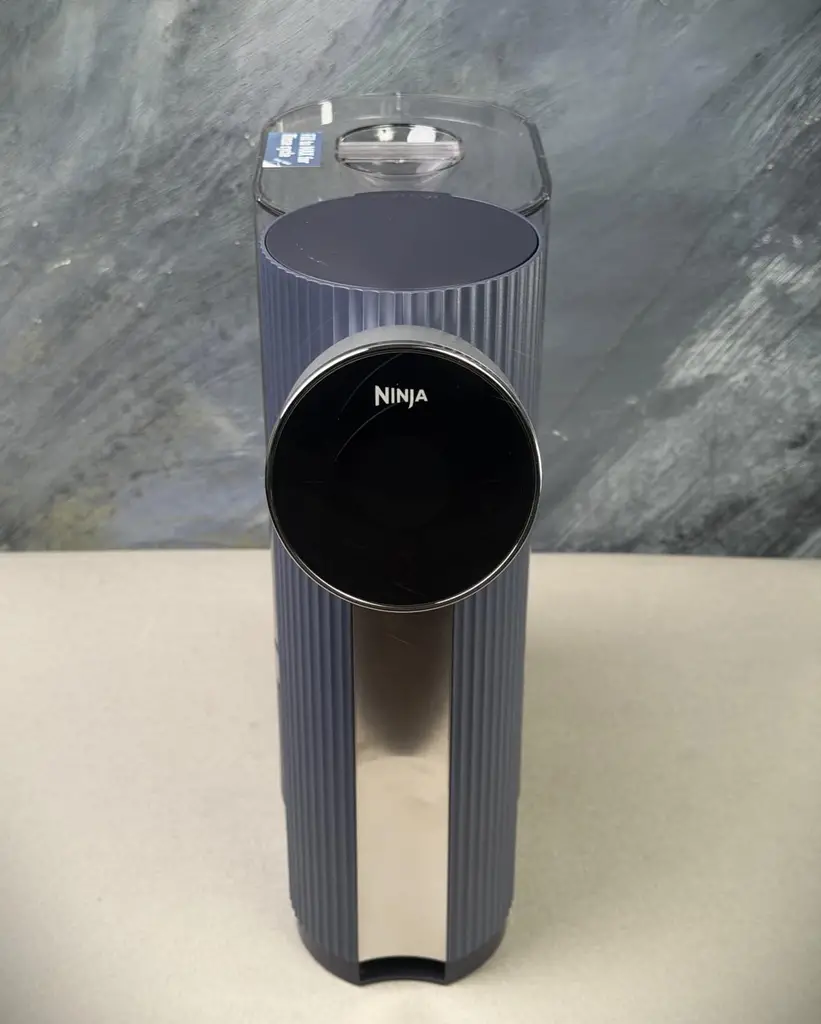
This is another area where the difference is obvious in everyday use. A traditional filter pitcher is simple, but the downside is that you have to wait for the water to pass through the filter. That isn’t a huge problem when you’re filling a glass, but it becomes annoying when you’re trying to fill a large bottle, coffee reservoir or several containers at once.
The HydraSense dispenses filtered water directly, so there’s much less waiting around. Ninja claims it filters up to six times faster than a standard Brita pitcher, and while I haven’t conducted a controlled test to verify that exact comparison, the practical experience has been very good. It feels fast enough that I don’t find myself planning ahead to make sure I have filtered water ready.
The 96-ounce reservoir is also useful because I’m not constantly stopping to refill it. That’s one of those features that sounds insignificant when reading the specifications but becomes more important after you’ve actually used the machine for a few days.
The Touchscreen and Automatic Dispensing Are Surprisingly Useful
The touchscreen is one of those features I wasn’t sure I would care about before buying the HydraSense, but I have ended up using the dispensing options more than I expected. You can choose specific amounts of water, which is handy when you’re filling a bottle or measuring water for coffee or cooking.
There is also a blue light that shines down into the cup while you’re dispensing. I didn’t expect to care about that either, but it makes the machine surprisingly convenient at night when the kitchen is dark. There is a red light when the reservoir isn’t seated properly, which is another small detail that makes sense once you’re actually using the appliance.
My only complaint with the automatic dispensing system so far is that getting to some of the options requires a few more button presses than I think should be necessary. If I’m only trying to get a small amount of water, I can sometimes get it faster simply by holding the dispense button rather than going through the menu. It’s not a serious problem, but it is one of those places where a future version of the software could probably be made a little more intuitive.
What About Cold Water?
This was one of my bigger concerns because I prefer very cold water. I didn’t want to spend this much on a countertop water filter only to end up with glasses of room-temperature water.
Fortunately, the reservoir can be filled with cold water, and you can even add ice. The HydraSense also has a recirculation function that helps move the colder water through the internal reservoir. The machine keeps a small amount of water inside before dispensing, so if you simply put a freshly refrigerated reservoir onto the machine, the first water that comes out isn’t necessarily as cold as the water you just put in.
I’ve found that running the recirculation cycle helps. It takes roughly 45 seconds, and I prefer running it twice when I want the water properly chilled. It’s not the same thing as having an actual refrigeration system built into the appliance, but it works well enough for me.
I actually think this is a clever solution because adding a compressor and active cooling system would make the machine considerably more complicated and expensive. Instead, Ninja gives you a way to work with cold or iced water without turning the HydraSense into another refrigerator.
I Tested the Water With a TDS Meter, But There Is an Important Catch
I also have a TDS meter, so naturally I wanted to see what happened to the readings after running different water through the HydraSense. My tap water measured 85, the Ninja HydraSense water measured 97, and my delivered filtered water measured 10.
At first glance, you might look at those numbers and assume the HydraSense somehow made the water “worse” because the TDS reading went up. I wouldn’t draw that conclusion. TDS, or total dissolved solids, is a limited measurement based on conductivity. It doesn’t tell you which substances are present, whether they are harmful, or whether a particular glass of water is healthier simply because it has a lower number.
In fact, a higher TDS reading is not necessarily surprising here because the HydraSense is designed to retain naturally occurring minerals rather than strip the water down toward zero dissolved solids. That’s also why I wouldn’t compare the HydraSense directly with a ZeroWater or reverse osmosis system simply by looking at the TDS number.
This is an important point because water-filter reviews can get very misleading when TDS meters are treated as if they are comprehensive water-quality testing equipment. They aren’t. My readings are useful as an observation of what happened to my particular water, but they don’t prove how effectively the HydraSense removed any specific contaminant.
Ninja HydraSense vs. Reverse Osmosis
This is probably the biggest question I would ask before buying one: what type of water do you actually want?
The Ninja HydraSense isn’t really competing with a full reverse osmosis system in the same way that a basic countertop pitcher isn’t. Reverse osmosis is designed to remove a very broad range of dissolved substances and can produce extremely low-TDS water. The trade-off is that RO systems generally involve more equipment, more maintenance and, depending on the system, water waste.
The HydraSense takes a different approach. It is designed for people who want substantially filtered water without removing all of the naturally occurring minerals. For me, that is actually a better fit than zero-TDS water because I mainly wanted to improve the taste of my tap water and reduce unwanted contaminants without installing a complicated system.
There are already some early users making the same basic comparison, with one noting that the HydraSense isn’t intended to compete with ZeroWater and another discussion questioning the lack of readily available performance documentation for the filtration standards. That doesn’t make the Ninja a bad product, but it does mean I would be careful about treating the big “80+ contaminants” marketing number as the same thing as independently verified water-quality testing.
Does Ninja HydraSense Really Remove 80+ Contaminants?
This is where I want to separate my experience from the manufacturer’s filtration claims.
Ninja markets the HydraSense as removing up to 99% of 80+ contaminants, including categories such as microplastics, pharmaceuticals, PFAS/forever chemicals and other unwanted substances. Those are significant claims, and I wouldn’t use my personal taste test or TDS meter to “prove” them. My experience tells me the machine made a very noticeable difference to the chlorine smell and taste in my water. It doesn’t tell me exactly how much of a particular pharmaceutical, PFAS compound or other contaminant was removed.
That distinction matters because water quality varies from one location to another. My water isn’t necessarily the same as your water, and the performance of a filter can depend on what is actually entering the system in the first place.
For that reason, I’m much more comfortable saying that the HydraSense has performed well for me so far than making the leap to saying every household will get identical results. There is also a bigger question that only time and more independent testing can answer: how consistently does the filter maintain that performance as it approaches the end of its useful life?
Filter Life Could Be One of the Best Things About It
One of the features I particularly like is the filter-life tracking. Instead of trying to remember when I installed a filter or relying on an arbitrary calendar reminder, the machine monitors usage and gives you information about the filter.
Ninja says the filter is designed to last up to 120 gallons, with replacement around twice a year for typical use. That’s considerably more convenient than constantly buying and changing small pitcher cartridges, assuming the real-world lifespan matches the advertised usage.
This is also an area where I think the HydraSense has a practical advantage over some cheaper alternatives. The appliance isn’t just filtering water; it is keeping track of how much water has passed through the system. For somebody who uses filtered water every day, that’s a genuinely useful feature rather than technology added simply because it looks impressive on a product page.
A Few Things I’m Watching Closely
Because I’ve only had the Ninja HydraSense for a few days, I don’t want to pretend I can give you a five-year reliability report. I can’t. The machine is new enough that most of the available customer feedback is still early ownership feedback rather than long-term experience.
So far, the majority of the feedback I found is positive, with people mentioning the easy setup, cleaner-tasting water, fast dispensing and attractive design. There are also some early complaints, including at least one customer reporting that the unit leaked despite following the troubleshooting steps. A current online discussion also includes another owner asking about water leaking from the front/bottom of the machine. These aren’t enough for me to call the HydraSense unreliable, but they are worth keeping in mind because leaks are exactly the kind of issue that becomes much more important if it turns out to be a recurring hardware problem.
I’m also interested in seeing how the filter performs after several months rather than several days. That’s the part of this review I simply can’t settle yet. A countertop filtration system can be fantastic during its honeymoon period, but the real value becomes much clearer after you’ve replaced the filter, cleaned the reservoir repeatedly and used the machine every day for a long stretch.
Is Ninja HydraSense Worth It?
For me, the answer so far is yes.
The biggest reason isn’t the touchscreen, the blue light or even the long list of contaminants Ninja says it removes. It’s much simpler than that: I didn’t like drinking my tap water, and I do like drinking it after it goes through the HydraSense.
The setup was easy, the machine looks good on my counter, the dispensing is fast, the automatic measurements are useful and I like being able to use cold water or ice rather than accepting room-temperature filtered water. Most importantly, the extremely strong chlorine smell and taste that bothered me are gone.
I also think the HydraSense makes more sense for someone who wants an upgrade from a standard Brita-style pitcher rather than someone specifically looking for reverse osmosis or zero-TDS water. If you’re already happy with a good carbon-filter pitcher, the question becomes whether the faster dispensing, larger reservoir, touchscreen, filter tracking and broader filtration claims justify spending more. For me, the convenience is part of what makes the purchase worthwhile.
The one thing I wouldn’t do is buy it simply because “99% of contaminants” sounds impressive and assume that makes it equivalent to every other type of water purification system. It isn’t. The filtration approach, the minerals it retains and the type of water it produces are all part of the equation.
Conclusion
After only a few days, I’m impressed with the Ninja HydraSense WF1001WH1, particularly because it has solved the problem I actually bought it to solve. My tap water had an unpleasant chlorine taste and smell, and the HydraSense has made it considerably cleaner and easier to drink. The machine is also much more convenient than waiting for a pitcher to slowly filter enough water for a bottle, coffee maker or cooking.
I would still call this an early review, rather than my final verdict. The long-term reliability, filter lifespan and how well the filtration holds up after months of use are going to determine whether this becomes an excellent value or simply an expensive countertop appliance that works well when new. That’s the part I’m going to be watching.
For now, though, I don’t regret buying it. If you want a countertop water filtration system without plumbing, don’t want to strip your water down to near-zero TDS, and mainly want better-tasting water with a much easier everyday experience than a traditional pitcher, the Ninja HydraSense is a very solid option. It isn’t perfect, and I wouldn’t buy it expecting a reverse osmosis system, but for what I personally wanted from a water filter, it has gotten off to a very good start.
Check out Mansculpt wave therapy plus that I talked about earlier.