
I didn’t expect to dislike the Snidin Bakuchiol Serum as much as I did. This was actually my second order from Snidin, and that is probably what made the disappointment worse. My first experience with the brand was their Centella Asiatica toner pads, which I absolutely loved and still consider some of the best toner pads I’ve used. So when I decided to try the Snidin Bakuchiol Serum, I went into it expecting another product that would quietly become one of those skincare staples I reach for without thinking about it. Instead, after using it and giving myself enough time to figure out whether I simply needed to adjust to the formula, I came to the conclusion that this particular serum just isn’t for me.
And that is a shame because, on paper, this is exactly the kind of formula that normally gets my attention. The Snidin Bakuchiol Serum contains bakuchiol along with ceramides, peptides and other skincare ingredients that make the product sound much more appealing than a basic hydrating serum. Bakuchiol is often marketed as a gentler alternative to retinol, while ceramides and other moisturizing ingredients can be useful for supporting the skin barrier. The price also seemed reasonable to me for a serum built around those ingredients, especially compared with how expensive some skincare products with similar formulas have become.
Unfortunately, the ingredient list was much more exciting to me than the actual experience of putting this serum on my face.
My Snidin Bakuchiol Serum Experience
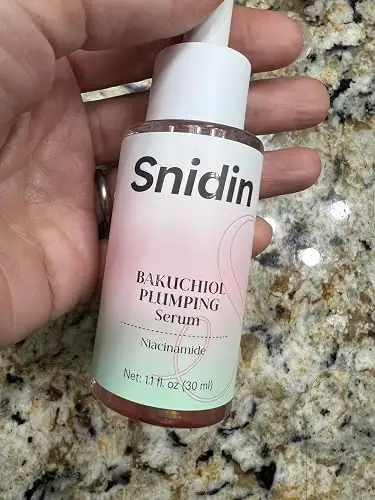
The first thing that bothered me was the texture. This isn’t one of those lightweight serums that disappears into your skin after a few seconds. It is noticeably thick and sticky, and I found that difficult to work with when I wanted to use other products afterward.
I normally like having several products available in my routine because different serums do different jobs, so I don’t particularly enjoy a product that leaves my skin feeling as though I’ve put a layer of glue over it. With this one, I wouldn’t recommend using it as your first serum layer if you have other serums you want to apply afterward. The stickiness makes layering unnecessarily awkward, and once I’ve already put several drops across my cheeks and forehead, I don’t want to spend the rest of my routine trying to convince another product to spread over the top of it.
I also found the consistency too thick for the kind of coverage I wanted. I tried using several drops, working it across my cheeks and forehead and giving it time to spread, but I still didn’t feel as though it was absorbing particularly well. Instead of that comfortable, slightly nourished feeling I expect after applying a serum, my skin was left feeling sticky on the surface while still looking dry underneath.
That combination was particularly disappointing because the Snidin Bakuchiol Serum contains ingredients that should make a moisturizing, barrier-supportive formula sound quite promising. I wasn’t expecting it to replace a moisturizer, but I did expect my skin to feel more comfortable and hydrated after applying it. For me, that simply wasn’t happening.
The Smell Was the Biggest Problem
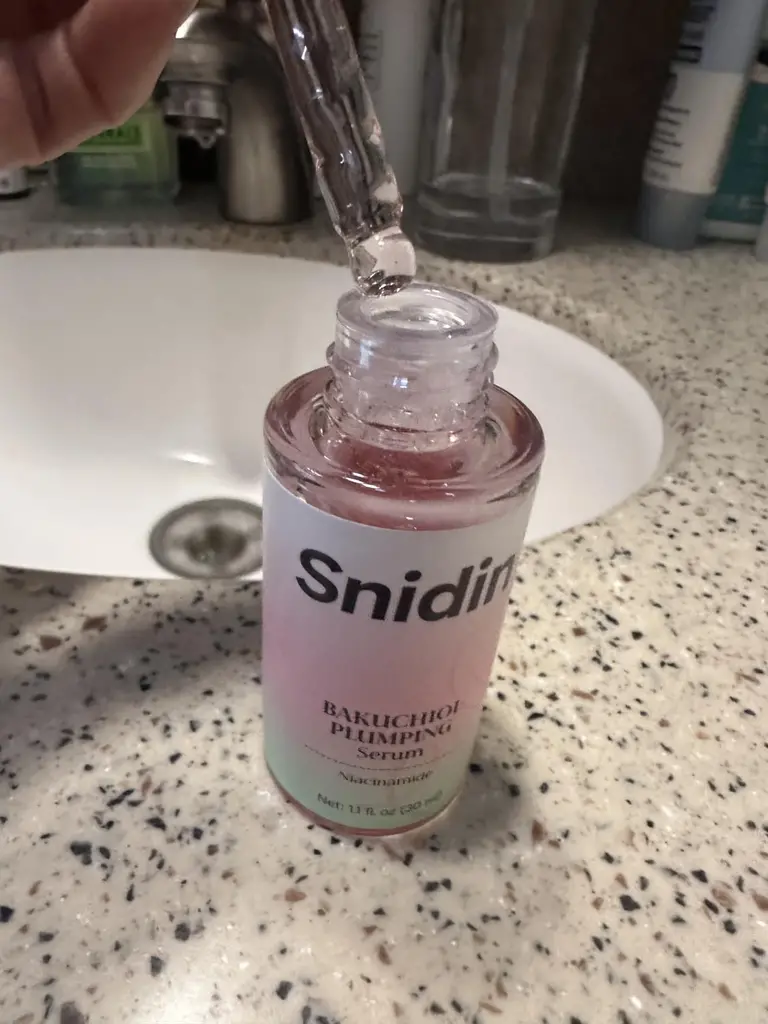
The texture was enough to make me question whether I would repurchase this serum, but the smell is what ultimately pushed me over the edge.
There is something about the scent that I really don’t like. I wouldn’t describe it as a normal clean skincare fragrance, and it isn’t a smell I could simply ignore once the serum was on my face. The closest comparison I can make is the smell I associate with some copper-peptide products. There is a slightly strange, almost metallic quality to it that I found unpleasant.
I did look at the ingredients to see whether there was an obvious fragrance ingredient that explained it. I didn’t see fragrance listed as the obvious culprit, and caffeine is one of the ingredients that can come up when looking at the formula. I genuinely don’t know what caffeine itself is supposed to smell like in a serum, so I can’t say that’s responsible for what I noticed. I was actually pleased to see caffeine in the formula when I ordered it because I’ve enjoyed caffeine in eye-care products and have used plenty of caffeine-containing Turkish hair-care products that I’ve liked.
Whatever the source of the smell, though, my reaction to the finished product was the same: I didn’t enjoy putting it on my face.
Bakuchiol Serum and My Skin Reaction
The part that made me stop using the Snidin Bakuchiol Serum altogether was what my skin looked like afterward. My face became noticeably red and dry, and the overall appearance reminded me of how my skin can look after using a stronger active such as retinol.
I know bakuchiol isn’t retinol, and I wouldn’t automatically blame the bakuchiol itself for the reaction. Skincare formulas contain multiple ingredients, and individual skin can react differently to products that are perfectly tolerable for somebody else. What matters to me as someone who actually bought the serum is that my skin did not look or feel happy after using it.
I also wasn’t getting the moisturizing effect I wanted from the product, so there wasn’t much incentive for me to keep pushing through the irritation just to see whether things improved. A serum is supposed to be something I enjoy using. When a product leaves my face looking red and dry while also feeling sticky, I don’t see a good reason to force myself to finish the bottle simply because the ingredient list looks good on paper.
What About the Snidin Centella Asiatica Toner Pads?
This is where my Snidin experience gets a little complicated, because I don’t want my disappointment with this serum to make it sound as though I think the entire brand is bad.
Quite the opposite, actually. My previous Snidin purchase was the Centella Asiatica toner pads, and those were the reason I was comfortable giving another Snidin product a chance in the first place. I really like those toner pads, and I have found them much more enjoyable to use than this serum.
The funny part is that when my skin became red and dry after using the Bakuchiol Serum, I ended up reaching for the Snidin Centella toner pads for some soothing relief. That pretty much sums up my experience with these two products. One was good enough that I wanted to buy from the brand again, while the other left me wishing I had simply ordered another pack of the toner pads instead.
That contrast is important because it also means I wouldn’t personally write Snidin off as a brand based on one disappointing product. Skincare brands can have formulas that work beautifully for one person and completely miss the mark with another, and even within the same brand, one product can be excellent while another simply doesn’t suit your skin.
Is Snidin a Korean Brand?
Another thing that came up around this product for me was the country-of-origin discussion.
Snidin is often presented in the broader C-beauty/K-beauty-inspired skincare space, and the packaging and marketing can certainly give the product the kind of aesthetic that people associate with Korean skincare. I already knew before ordering that Snidin products were made in China, so that wasn’t a surprise to me.
The phrase “inspired by K-beauty tradition” also didn’t lead me to believe that the product itself was necessarily manufactured in Korea. I understand why some shoppers become frustrated when they feel a product’s branding has made its origin unclear, but that wasn’t my issue with the serum. I knew what I was buying in that respect.
My problem was much more straightforward: I didn’t like the formula on my skin.
For me, country of manufacture wasn’t what determined whether this serum was good or bad. The texture, smell, lack of the moisturizing effect I wanted and the way my skin looked after using it were the things that made the decision for me.
Is the Snidin Bakuchiol Serum Worth Buying?
For my skin, no. I wouldn’t buy it again, and I won’t be finishing the bottle.
The interesting thing is that I don’t think the product looks unreasonable based purely on its ingredients or price. Bakuchiol, ceramides, peptides and other supporting ingredients make it an appealing formula on paper, and I don’t think the price is outrageous for what is included. The problem is that skincare isn’t a spreadsheet where the better-looking ingredient list automatically wins.
Texture matters. Smell matters. How a product layers matters. And, most importantly, how your actual skin responds matters.
For me, the Snidin Bakuchiol Serum failed on too many of those practical points. It was too sticky, too thick, didn’t give me the moisturizing finish I expected, smelled unpleasant to me, and left my skin looking red and dry. At that point, it doesn’t matter how attractive the ingredient list looks because I’m not going to enjoy using it.
Conclusion
My final opinion is probably more disappointing precisely because I already liked Snidin.
Had this been my first experience with the brand, I might have simply moved on and decided Snidin wasn’t for me. But I had already bought their Centella Asiatica toner pads and loved them, so I genuinely expected the Bakuchiol Serum to be another good find. Instead, it turned out to be one of those skincare purchases where the product sounds considerably better on paper than it feels when you’re actually standing in front of the bathroom mirror trying to spread it across your face.
I’m also glad I didn’t keep using it simply because I had paid for it. Once my skin started looking red and dry and I realized I wasn’t enjoying the texture or smell either, there really wasn’t anything convincing me to finish the bottle. I’ve gone back to the Snidin Centella toner pads instead, which is slightly ironic considering those were the product that convinced me to try the serum in the first place.
So, is Snidin Bakuchiol Serum legit? Yes, I have no reason to suggest that the serum itself is some kind of fake product. But is it a good serum for me? Absolutely not. My experience was disappointing enough that I would skip this particular formula and spend the money on a product I already know my skin enjoys.
The ingredient list had me interested, the price seemed fair, and my previous experience with Snidin had me expecting another winner. Unfortunately, the finished formula just didn’t work for me. Sometimes a product can look perfect on the ingredient list and still be completely wrong once it meets your skin, and that is exactly what happened here.