
A supplement with 4.9 stars on Trustpilot and hundreds of positive reviews sounds like a safe choice, especially when it is being sold to people looking for relief from nerve pain, tingling, burning sensations or other uncomfortable symptoms. That is the kind of impression Noverly R-Alpha Lipoic Acid creates, and I can understand why someone looking for help might be tempted to order it.
Noverly sells 600mg softgels containing what it describes as pure R-form alpha lipoic acid, with a bottle priced at $49.99. The website promotes the supplement using research into alpha lipoic acid and makes its customer ratings and money-back guarantee part of the sales pitch. On the surface, it looks like a carefully presented supplement backed by scientific research and satisfied customers.
But when I looked more closely at the claims, the reviews and the return policy, the picture became much less convincing. The famous ALADIN and SYDNEY studies often discussed in connection with alpha lipoic acid used a mixture of its R and S forms, not the pure R-form product Noverly is selling. I also found a Trustpilot review promotion offering a free $45 gift for positive reviews, with suggested talking points and an indication that reviewers did not necessarily have to try the product first. Meanwhile, the advertised 90-day guarantee appears to have a major limitation: the refund policy covers unopened, sealed bottles only.
These details matter because customers are being asked to trust the product partly on the strength of its research, its reviews and its guarantee. Here is what I found about Noverly R-Alpha Lipoic Acid and why I would be cautious about buying it.
What Is Noverly R-Alpha Lipoic Acid?
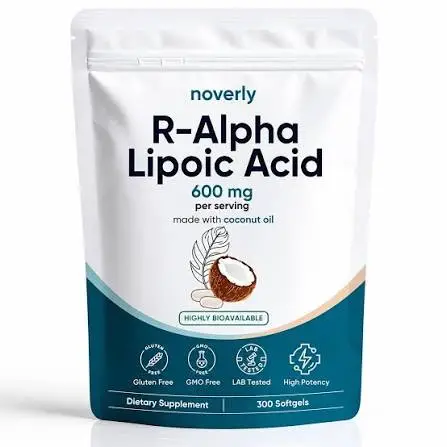
Noverly R-Alpha Lipoic Acid is a dietary supplement sold in 600mg softgels. Its main ingredient is alpha lipoic acid, a compound involved in the body’s energy metabolism that has also been studied for its potential effects on certain symptoms associated with nerve damage.
Alpha lipoic acid comes in two forms, known as R-alpha lipoic acid and S-alpha lipoic acid. The R-form occurs naturally in the body, while many conventional supplements and several of the better-known clinical studies have used a mixture containing both forms. Noverly specifically promotes its product as pure R-form alpha lipoic acid, which is an important detail when assessing whether the research it cites actually supports the claims being made.
The supplement is marketed toward people concerned about nerve health and related symptoms. That can be an appealing proposition for someone dealing with burning feet, tingling or discomfort that affects everyday life. However, a supplement containing an ingredient that has been studied for a particular condition is not automatically proven to work for that condition in the formulation and dose being sold.
At $49.99 per bottle, I would expect the company to explain its product clearly and provide evidence that relates directly to the formula. Instead, some of the marketing appears to lean heavily on research involving different formulations, alongside customer ratings that deserve a closer look.
The ALADIN and SYDNEY Studies Do Not Prove Noverly Works
One of the most important issues with Noverly’s marketing is how research on alpha lipoic acid is used to support the product’s claims.
The ALADIN and SYDNEY trials are well-known studies that investigated alpha lipoic acid in people with diabetic peripheral neuropathy. These studies used racemic alpha lipoic acid, meaning a mixture of the R and S forms, rather than the pure R-form supplement Noverly advertises.
The ALADIN trial investigated intravenous alpha lipoic acid in people with diabetic neuropathy, while the SYDNEY study also examined treatment in this area. The research reported improvements in certain neuropathy symptom scores under the conditions studied. That is relevant research, but it does not establish that every alpha lipoic acid supplement will produce the same results.
There are two things to keep in mind here. First, the formulation matters. A study using a mixture of R and S alpha lipoic acid does not directly prove that a supplement containing only the R-form will have the same effects when taken orally at home. Second, the outcomes matter. Improvements in symptom scores are not the same as proving that damaged nerves have been repaired or that an underlying condition has been cured.
This is where I have a problem with marketing that makes scientific research sound like a direct endorsement of a specific product. The studies may be genuine, but Noverly still needs evidence that supports the claims made about its own supplement. Research on an ingredient is not a substitute for testing the actual product being sold.
I could not establish from the information provided that Noverly’s particular 600mg R-form softgels have been shown in suitable clinical trials to repair nerves or reliably deliver the results its marketing may lead customers to expect. I would therefore be wary of buying the product based on the ALADIN and SYDNEY studies alone.
Noverly R-Alpha Lipoic Acid Costs $49.99
Noverly lists its 600mg R-alpha lipoic acid supplement at $49.99 per bottle. That is a meaningful amount of money, particularly for someone who may be considering taking the supplement regularly rather than buying it just once.
The price is not necessarily unreasonable simply because cheaper supplements exist. A product’s cost can depend on its ingredients, manufacturing standards, testing and other factors. However, if a company charges a premium for a particular form of an ingredient, it should explain what supports that price and provide enough information for customers to make an informed decision.
I would want to know how the company verifies the purity and strength of its R-alpha lipoic acid, whether the finished product is independently tested and whether those results are available to customers. The words “pure R-form” may sound reassuring, but the claim is much more useful when supported by verifiable testing.
The website also appears to use numerous pages promoting the product from different angles, with around 50 near-identical pages reportedly tailored to different health conditions. Creating separate pages for different audiences is not proof of wrongdoing on its own, but it becomes concerning when the same supplement is repeatedly presented as an answer to a wide range of problems without clear evidence supporting each claim.
People looking for help with different symptoms may arrive at different pages and come away with the impression that the supplement was specifically developed for their particular concern. In reality, the important question remains the same: what reliable evidence shows that this exact product helps with the condition being discussed?
The 4.9-Star Trustpilot Rating Has a Problem
Noverly’s Trustpilot profile reportedly displays a 4.9-star rating based on 459 reviews. At first glance, that is an impressive score, and many shoppers would naturally take it as a sign that customers are happy with the company.
However, the review promotion associated with Noverly raises serious questions about how much confidence to place in that rating. The promotion reportedly offers a free gift worth $45 for four- or five-star reviews, provides suggested talking points and says reviewers do not need to have tried the product first.
That is a significant concern. If someone can receive a gift for leaving a positive review without having used the supplement, their review cannot reliably tell another customer whether the product works. Suggested talking points can also steer people toward repeating the company’s preferred claims rather than describing an independent experience.
There is an important difference between asking customers for honest feedback and offering an incentive specifically tied to positive ratings. A company can reasonably encourage customers to share their experiences, but rewarding four- or five-star reviews creates a clear risk that the overall score will present a more favourable picture than the product deserves.
I cannot conclude that all 459 reviews are fake or that every person who left a positive rating participated in the promotion. The available information does not establish that. However, the reported offer is enough to make me question whether the 4.9-star rating is a reliable way to judge the supplement.
For a product being sold on health-related claims, that matters. Customers need genuine feedback from people who have actually purchased and used the supplement, not testimonials that may have been influenced by gifts or written before the reviewer had any experience with it.
What About Noverly’s 4.8 Stars From More Than 50,000 Reviews?
The company’s own website reportedly displays a 4.8-star rating based on more than 50,312 reviews. That is a much larger figure than the 459 reviews associated with its Trustpilot profile, but the two numbers should not be treated as directly comparable.
The website’s rating is hosted by the seller, whereas Trustpilot is an external review platform. Neither a large number of reviews nor a high score automatically establishes that a supplement works, and seller-hosted testimonials do not provide the same level of independence as feedback collected outside the company’s own sales environment.
I also found that a statistics widget on the site appeared to be stuck at 0%. Without knowing exactly what the widget is intended to measure, I would not claim that this proves the review figures are fabricated. It does, however, raise questions about the accuracy and maintenance of the website’s presentation.
When a company advertises tens of thousands of reviews, it should be possible to understand where those reviews came from, which products they refer to and whether they represent verified purchases. If the figures cannot be clearly explained, they should not be used as the main reason to trust the product.
Taken together, the store’s large review count and the Trustpilot incentive raise questions that the company should answer. I would not treat the ratings as conclusive evidence that Noverly R-Alpha Lipoic Acid delivers the results its marketing suggests.
The 90-Day Money-Back Guarantee Is Not What It Sounds Like
Noverly also promotes a 90-day guarantee using language that suggests customers can pay nothing if they see no difference. For someone spending $49.99 on a supplement, that sounds reassuring because it appears to offer an opportunity to try the product without taking much financial risk.
The problem is that the stated return policy reportedly covers unopened, sealed bottles only. If that is how the policy applies to the purchase, it creates a major practical issue for anyone who opens the supplement and uses it to find out whether it helps.
Think about it from the customer’s point of view. You buy the product because you want to see whether it makes a difference, but after using it, you find that it has not helped. You then try to use the advertised guarantee, only to discover that the bottles must remain unopened and sealed to qualify for a refund.
That is not what many people would expect from a promise that they can pay nothing if they see no difference. A guarantee is only useful if the conditions are clear and match the impression created by the headline claim.
I would not assume that the 90-day guarantee means you can use the supplement for three months and then return it if it does not work. Based on the reported policy, the restriction on opened bottles is a serious limitation that customers should understand before placing an order.
Before buying, I would read the complete refund terms rather than relying on the wording in the advertisement. If the company does not clearly explain how an opened bottle is treated under the guarantee, I would be reluctant to risk my money.
Is Noverly R-Alpha Lipoic Acid Worth Buying?
For me, the biggest issue is the gap between what the marketing suggests and what the available evidence establishes. Noverly sells a specific 600mg R-form supplement, but some of the research associated with alpha lipoic acid involves a racemic mixture and measures changes in symptoms rather than demonstrating nerve repair.
The review situation also makes it difficult to judge the company’s reputation with confidence. A 4.9-star Trustpilot score might look impressive, but the reported offer of a $45 gift for positive reviews, including suggested talking points and no requirement to have tried the product, undermines the value of that rating. The store’s own 4.8-star score and very large review count do not resolve those concerns, particularly when the figures are presented on the seller’s own website.
Then there is the guarantee. Advertising a 90-day promise that suggests customers pay nothing if they see no difference, while the stated policy covers unopened, sealed bottles only, could leave buyers with a very different understanding of their refund rights from the one they formed when seeing the sales pitch.
I would not spend $49.99 on this supplement based on those claims alone. The company needs to provide clearer evidence for its product-specific benefits, more transparent information about its reviews and a straightforward explanation of the guarantee.
Is Noverly R-Alpha Lipoic Acid Legit or a Scam?
Noverly R-Alpha Lipoic Acid is a real supplement offer, but that does not mean its marketing should be trusted without question. The issues I found are substantial: the research used to support its claims does not directly establish the effectiveness of its pure R-form formula, the Trustpilot review promotion creates a serious concern about the credibility of the ratings, and the 90-day guarantee appears far less generous when the unopened-bottle restriction is taken into account.
I cannot establish that every positive review is fake or that the company is committing fraud, but I do not think the advertised ratings and guarantee provide enough reassurance to make this a purchase I would recommend. The reported review incentive is particularly troubling because customers looking for help with nerve-related symptoms deserve honest information, not a rating that may be influenced by rewards for positive feedback.
I would avoid buying Noverly R-Alpha Lipoic Acid until the company provides clearer evidence for its claims and explains its review and refund practices. A high star rating is not a substitute for reliable clinical evidence, and a money-back guarantee is not much comfort if you cannot use it after opening the product. At $49.99 a bottle, I would want far more transparency before trusting this supplement with my money.
Check out Necklow Sleep Pillow that I reviewed, earlier.