
Buying a good home theatre projector is not a small investment, especially when you are looking at models around the $6,000 mark. At that price, you want more than a big picture on your wall. You want sharp images, convincing colours, good contrast and a projector that makes watching films at home feel like a proper cinema experience. The Sony VPL-XW5000ES is one model that has attracted plenty of attention because it brings native 4K resolution and laser lighting into a relatively affordable package compared with some of Sony’s more expensive home cinema projectors.
The VPL-XW5000ES sells for around $5,999 in the US and £5,999 in the UK. Sony has managed to keep the price lower partly by making some compromises with the design and features, but the important question is whether those compromises matter once you start using it. From what I have found in the reviews and specifications, this is a projector that gets several important things right, although there are a few features I would have liked to see at this price.
What Is the Sony VPL-XW5000ES?
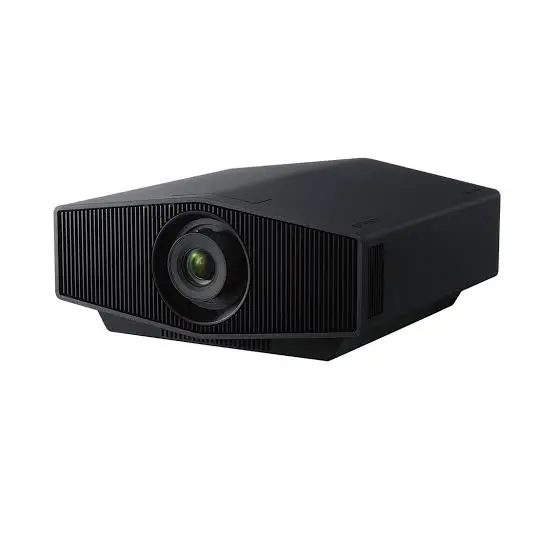
The Sony VPL-XW5000ES is a native 4K laser home theatre projector designed for people who want a large, detailed picture without stepping up to Sony’s more expensive models. It uses Sony’s SXRD display technology, which is known for producing sharp images and good contrast.
One thing I particularly like about its specifications is that this is genuine native 4K projection rather than a lower-resolution projector using pixel shifting to simulate a higher resolution. Sony uses three 0.61-inch SXRD panels, each handling one of the primary colours, to produce a 3840 x 2160 image. This means you get the full 4K pixel count on screen, which is especially useful when watching high-quality 4K films or viewing content with lots of fine detail.
The projector also has a smaller and lighter body than some of Sony’s previous native 4K models. That makes it easier to accommodate in a home theatre room, although installation still needs some planning because this is not a small living-room projector that you can simply move around whenever you feel like watching something.
Sony has also included its X1 Ultimate for Projector video processor, bringing some of the company’s more advanced image processing features to this model. It handles HDR enhancement, colour reproduction and other picture adjustments designed to make films look more natural and detailed.
Picture Quality: Where the Sony XW5000ES Makes Its Case
For me, picture quality is the main reason to consider spending this much on a projector, and the Sony VPL-XW5000ES has some impressive hardware behind it. Its native 4K resolution gives it an advantage for anyone who regularly watches UHD films, particularly on a large projection screen where small details become easier to notice.
Sony’s SXRD technology also helps produce a smooth, detailed image. Colours look rich without having to make everything unnecessarily bright or oversaturated, and the projector’s Triluminos Pro processing is designed to reproduce a wide range of colours. Sony claims coverage of around 95% of the DCI-P3 colour space, which is useful for displaying the wider colour range found in many HDR films.
Another feature worth mentioning is the Dynamic HDR Enhancer. HDR content can sometimes look disappointing on projectors because they cannot produce the same peak brightness as modern televisions. Sony uses its processing to adjust the image and make bright areas stand out while maintaining detail in darker scenes. The object-based HDR remastering also works to improve the appearance of different parts of the picture rather than treating the entire image in exactly the same way.
Of course, the room and screen you use will have an effect on the final result. A dedicated home theatre room with controlled lighting will allow the projector to show what it can really do. If you have bright lights coming through the windows, you should not expect the same picture quality you would get in a properly darkened room.
Brightness and Laser Light Source
The Sony VPL-XW5000ES is rated at 2,000 ANSI lumens, which is respectable for a native 4K home theatre projector. Independent measurements have placed its brightness in the region of approximately 1,602 to 2,146 lumens, depending on the picture mode and measurement conditions.
This should be enough for a dedicated cinema room, particularly when paired with a suitable screen. However, I would not buy it expecting television-like brightness in a room filled with daylight. Projectors generally need some control over the lighting conditions to deliver their best results, and this Sony is no exception.
Its Z-Phosphor laser light source is another major advantage. Sony rates the laser for approximately 20,000 hours of use, which means you do not have to worry about buying replacement projector lamps every few years. That is a welcome improvement for anyone who watches films regularly.
Think about how much time you could spend watching movies, television shows and sports without having to deal with the usual lamp replacement routine. The laser also provides more consistent brightness over time than a traditional lamp-based projector, although brightness will still gradually decrease as the light source ages.
Gaming Performance: Is It Good for Console Gaming?
The Sony XW5000ES is not marketed as a dedicated gaming projector, but it does offer some features that make it suitable for people who enjoy playing games on a large screen.
Sony includes a low-latency mode, with reported input lag of approximately 21ms at 4K/60Hz and 13ms at 1080p/120Hz. These figures are respectable for a home theatre projector, and they should make the experience enjoyable for many console and PC gamers.
However, there is something important to understand before buying it. The projector has two HDMI 2.0b ports rather than HDMI 2.1. That means you do not get the full HDMI 2.1 feature set found on newer gaming displays, including 4K at 120Hz over HDMI.
For someone who mainly plays single-player games, racing games or adventure titles, this may not be a major problem. But if you own a newer gaming console and specifically want the highest refresh rates and latest HDMI features, the XW5000ES may leave you wanting more.
The Biggest Disappointment: No Motorized Lens Memory
There is one feature I would seriously consider before buying this projector: the lack of motorized lens memory.
This might not matter much if you use a fixed screen with one aspect ratio and never change your viewing setup. However, people who watch films in different aspect ratios may find it frustrating. Some movies are presented in widescreen formats that leave black bars at the top and bottom of the screen, while others use a different picture shape.
With motorized lens memory, a projector can store different lens positions and zoom settings, making it easier to switch between screen formats. The Sony XW5000ES does not offer this convenience, so anyone who wants to use different aspect ratios will have to make adjustments manually.
At nearly $6,000, I think this is something worth considering. The projector produces an excellent picture, but a home theatre setup is about convenience as well as image quality. If you regularly watch movies in different formats, this missing feature could become annoying.
Sony VPL-XW5000ES vs JVC NP5 vs Epson LS12000
The Sony is not the only projector worth considering in this price range. Two alternatives that deserve attention are the JVC DLA-NP5 and Epson Pro Cinema LS12000, although they take different approaches.
Sony VPL-XW5000ES: Sony’s biggest selling point is its native 4K SXRD technology combined with a laser light source. You get detailed images, good colour reproduction and the convenience of not having to replace a traditional lamp. It is a strong choice for someone who values native 4K resolution and wants a laser projector without moving into Sony’s more expensive range. Its main disadvantage is the lack of motorized lens memory.
JVC DLA-NP5: If your priority is picture quality, particularly contrast and black levels, the JVC NP5 deserves a serious look. It uses native 4K D-ILA technology and offers higher native contrast than the Sony, along with motorized lens memory and JVC’s built-in dynamic HDR tone mapping. The downside is that it uses a traditional lamp rather than a laser light source, so you will eventually need to replace the bulb.
Epson Pro Cinema LS12000: This is another interesting alternative for people who want a laser projector with useful installation features. It offers motorized lens memory and a laser light source, making it a convenient choice for a dedicated home theatre setup. However, it does not deliver quite the same native contrast performance as the Sony’s SXRD system.
Personally, I would look closely at the JVC NP5 if black levels, contrast and lens memory matter more to you than having a laser light source. The Epson LS12000 also makes sense if you want the convenience of laser illumination and motorized adjustments without paying for the Sony.
Is the Sony VPL-XW5000ES Worth $5,999?
The Sony VPL-XW5000ES is a very capable home theatre projector, and there is a good reason it gets attention from people shopping for native 4K models. Its SXRD panels produce a detailed 4K picture, the laser light source removes the need for regular lamp replacements, and Sony’s X1 Ultimate processing helps deliver attractive colours and improved HDR performance.
I also like that Sony has managed to bring these features into a smaller and lighter design without turning the projector into an entry-level model. For someone building a dedicated cinema room, it offers plenty to get excited about.
However, I would not call it the automatic best choice under $6,000. The lack of motorized lens memory is a genuine drawback, especially when competing models offer it. The JVC NP5 has an advantage in native contrast and HDR tone mapping, while the Epson LS12000 offers a laser light source and motorized lens adjustments.
You can check out the Sony VPL-XW5000ES if you want native 4K resolution, excellent image processing and the convenience of laser projection. But if you are spending close to $6,000, I would compare it carefully with the JVC NP5 and Epson LS12000 before making a decision. Sony has done a lot right here, but the missing lens memory means it will not be the best fit for every home theatre enthusiast.
Check out Necklow Sleep Pillow that I reviewed, earlier.