
I have a soft spot for skincare products that don’t promise to completely reinvent your face overnight. Give me a good serum that makes my skin feel smoother, more hydrated and a little more alive, and I’m interested. That is what caught my attention with the Thallo Advanced Regeneration Multi-Peptide Serum with Copper Complex.
At first glance, this looks like another anti-aging peptide serum trying to win attention with a long ingredient list and big promises about collagen. But once I looked more closely at the formula, there is actually something worth talking about here—particularly the combination of Copper Tripeptide-1 with five other peptides.
The bigger question is whether that makes Thallo Multi-Peptide Serum a genuinely worthwhile addition to an anti-aging skincare routine, or whether “copper complex” is simply being used as another impressive-sounding ingredient on the label.
After looking at the formula, the company’s claims, the available research on copper peptides and the customer feedback I could find, my view is a little more measured: Thallo Multi-Peptide Serum is a legitimate peptide-based skincare product with some interesting ingredients, but the marketing gets ahead of what can actually be proven about this particular serum.
What Is Thallo Multi-Peptide Serum?
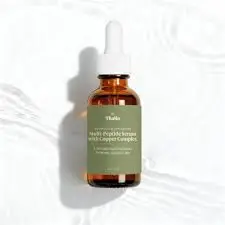
Thallo Multi-Peptide Serum is a facial treatment designed primarily for mature or aging skin. It is marketed as a lightweight, fast-absorbing serum that can be used morning and night to improve the appearance of firmness, elasticity, fine lines, wrinkles and overall skin texture.
The formula contains six peptide technologies, with Copper Tripeptide-1 taking center stage. It also contains hyaluronic acid, aloe, glycerin, witch hazel, jojoba oil, Manuka honey extract, Centella asiatica and several botanical extracts.
The current product page lists the serum at $59, although the company displays a higher regular price alongside promotional pricing. It also advertises a money-back guarantee.
That pricing puts it somewhere in the middle of the crowded peptide-serum market. It isn’t an ultra-cheap drugstore serum, but it also isn’t priced like some luxury anti-aging treatments.
Ingredients: What’s Inside?
This is probably the part of the product I found most interesting.
The featured peptides are:
- Copper Tripeptide-1
- Palmitoyl Tripeptide-5
- Palmitoyl Tripeptide-1
- Palmitoyl Tripeptide-38
- Palmitoyl Tetrapeptide-7
- Acetyl Hexapeptide-8
There is also sodium hyaluronate, which is a form of hyaluronic acid, along with glycerin and sodium PCA for hydration.
So this isn’t a serum where the word “peptide” appears on the front of the bottle while there is barely anything relevant in the formula. There really are multiple peptides present.
The catch is that an ingredient appearing on an ingredient list doesn’t tell us the concentration, stability or delivery performance of each active. Thallo does not publicly provide the percentage of each peptide on the product page. That matters because you cannot determine the actual strength of a peptide serum simply by counting how many peptides are listed.
In other words, six peptides sounds impressive, but six peptides doesn’t automatically mean six times the results.
Does Copper Tripeptide-1 Really Work?
This is where Thallo has something more substantial going for it.
Copper Tripeptide-1 is commonly referred to as GHK-Cu, a copper-binding peptide that has been studied for skin regeneration, wound healing and cosmetic applications. Research into topical GHK-Cu has reported improvements in things such as skin thickness, density, elasticity and the appearance of fine lines in some human studies.
A review published in 2026 also describes GHK-Cu as one of the better-known peptides in regenerative aesthetics and notes its research history in skin health and repair.
So when Thallo talks about Copper Tripeptide-1 supporting skin renewal, the ingredient itself isn’t made up. There is legitimate scientific interest behind it.
But here’s where I would slow down before getting carried away.
Research on GHK-Cu is not the same thing as clinical proof that Thallo’s finished serum will erase wrinkles, rebuild collagen or make someone’s face look years younger.
Those are two very different claims.
Some of the human research on topical GHK-Cu is promising, but the studies are not large enough or consistent enough to justify treating every copper peptide serum as a proven anti-aging treatment. There are also studies where copper tripeptide products did not produce significant objective improvements compared with controls in certain post-procedure settings.
So yes, the copper peptide has a credible scientific basis, no, that doesn’t mean Thallo can guarantee dramatic results.
What About the Other Peptides?
This is another reason I don’t think it is fair to dismiss the serum as a gimmick.
Several of the other peptides are widely used in cosmetic formulations aimed at improving the appearance of wrinkles and firmness. Palmitoyl peptides, for example, are commonly used as signal peptides in anti-aging skincare.
Acetyl Hexapeptide-8 is also a familiar cosmetic peptide, particularly in products marketed around expression lines.
The overall idea behind Thallo is therefore pretty straightforward: instead of depending on one peptide, the formula combines several peptide types with humectants and botanical ingredients.
That is a reasonable formulation strategy.
But again, more ingredients don’t automatically equal better results.
A good skincare formula isn’t necessarily the one with the longest ingredient list. What matters is whether the ingredients are present at useful concentrations, remain stable in the formula and actually perform when applied to real human skin.
Thallo doesn’t give shoppers enough concentration information to make that judgment.
Can It Really Boost Collagen?
This is probably the biggest claim I’d put a question mark beside.
The company describes its peptides as signaling the skin to support collagen production and repeatedly connects the serum with firmer, fuller-looking skin.
There is research showing that certain peptides, including GHK-Cu, can influence collagen-related processes. Human studies have also reported improvements in skin density and wrinkle appearance with topical copper peptide formulations.
But I wouldn’t translate that into “this serum boosts your collagen and reverses aging.”
Skin doesn’t work that simply, a topical serum can potentially improve hydration and the appearance of fine lines while also supporting processes associated with healthier-looking skin. That is very different from literally restoring youthful skin structure.
For me, “supports collagen” is a reasonable skincare claim; “rebuilds your face” is not.
What Are Customers Saying?
Things get interesting here, because the feedback isn’t completely one-sided.
On the Shop app, the product currently shows a 4.5 rating from more than 1,200 ratings on the product listing, although the individual written reviews displayed there are a much smaller sample. Some customers describe the serum as absorbing quickly and making their skin feel softer, fuller or more hydrated. One customer said they were already using a second bottle and felt it was helping with general plumpness and softening lines.
There is also less enthusiastic feedback. One reviewer said the product felt like it was sitting on the skin rather than absorbing, while another person who had only used it for about a week reported softer and slightly fuller-feeling skin.
That actually sounds much more believable to me than pages full of people claiming that every wrinkle disappeared.
A skincare product can feel lovely, improve hydration and make the skin appear temporarily plumper without producing dramatic structural changes, and the length of use matters. A week is far too soon to judge an anti-aging peptide serum based on wrinkle reduction.
Is Thallo Multi-Peptide Serum Good for Mature Skin?
This is where I think the product makes the most sense.
Mature skin often benefits from products that focus on hydration, barrier support and gradual improvement in the appearance of fine lines, rather than constantly throwing strong exfoliating acids or retinoids at the skin.
Thallo is fragrance-free according to the brand and does not rely on exfoliating acids or retinoids. That may make it appealing to people who already find stronger anti-aging products irritating.
The formula also includes glycerin, hyaluronic acid, aloe and other moisturizing ingredients, so there is more happening here than simply loading the bottle with peptides.
That said, I wouldn’t automatically call it suitable for every sensitive-skin user.
The ingredient list contains witch hazel, honey extract and numerous botanical extracts. The brand itself acknowledges that some of these ingredients may cause sensitivity in people with allergies or reactive skin and recommends patch testing.
So “gentle” shouldn’t be interpreted as “impossible to react to.”
How Do You Use Thallo Multi-Peptide Serum?
The brand recommends using it morning and evening.
The basic routine is:
- Cleanse your face.
- Pat the skin dry.
- Apply around 3–4 drops of serum to the face and neck.
- Gently massage or press it into the skin.
- Follow with moisturizer.
- In the morning, finish with sunscreen.
The company says the serum can be layered underneath moisturizer and SPF and is designed to absorb quickly.
Personally, I wouldn’t pile several strong active serums on top of it just because the product is marketed as a “regeneration” treatment. A simple routine is often easier to stick with, and consistency matters much more than having ten products sitting on your bathroom counter.
How Long Does Thallo Take to Work?
This is another area where I would keep expectations realistic.
Thallo’s marketing describes noticeable hydration and texture changes early on, followed by more visible improvements in firmness and fine lines over several weeks. The company recommends giving the product at least 60 days before judging the full effect.
That timeline makes more sense than expecting overnight wrinkle removal, i your skin is dry, you may notice a softer and more hydrated appearance relatively quickly because of ingredients such as glycerin and hyaluronic acid.
Peptide-related changes are a different story. You need consistent use over time before deciding whether a product is actually helping with fine lines or firmness, and even then, the changes are likely to be subtle rather than dramatic.
Is Thallo Multi-Peptide Serum a Scam?
I don’t see enough evidence to call Thallo Multi-Peptide Serum a scam.
The product has a real ingredient list, contains recognized cosmetic peptides, and Copper Tripeptide-1 is a legitimate ingredient with published research behind it. There are also customer reviews describing positive experiences with the serum.
Where I think shoppers need to be careful is with the marketing language.
Claims such as “erases expression lines without injections” sound much more dramatic than what I would expect from a topical cosmetic serum.
The science supports being interested in copper peptides. It does not give us a reason to believe that putting this particular serum on your face will produce Botox-like results.
What I Think
So, does the Thallo copper complex work?
The answer is: Copper Tripeptide-1 itself has legitimate research behind it, but that doesn’t prove that Thallo’s serum will deliver all of the dramatic results promised in its marketing.
I actually like the concept of this formula. The combination of Copper Tripeptide-1, several additional peptides, hyaluronic acid and moisturizing ingredients makes more sense to me than a serum built around one trendy ingredient.
What I like most is that you aren’t buying a bottle containing nothing but a fancy “copper complex” story. There is a substantial peptide component here.
What I don’t love is the leap from “this ingredient has research behind it” to language suggesting the finished product can erase expression lines or essentially reverse visible aging.
For someone looking for a copper peptide serum for mature skin, especially someone who wants a gentler alternative to a retinoid-heavy routine, Thallo is worth considering. Just don’t buy it expecting your wrinkles to disappear in a few weeks.
I’d rate it 4 out of 5 stars based on the formula, ingredient profile, available evidence and customer feedback./
Conclusion
Thallo Multi-Peptide Serum looks like a legitimate peptide skincare product, and the Copper Tripeptide-1 is not just marketing fluff. The science behind copper peptides is interesting and reasonably encouraging. But the finished Thallo serum has not been independently shown to produce the dramatic “age reversal” results suggested by some of its advertising. If you’re looking for gradual improvements in hydration, texture, fine lines and the overall appearance of firmness, this is a much more realistic way to look at it.
And that’s probably the biggest thing I’d want anyone shopping for Thallo Multi-Peptide Serum to understand: there is a real ingredient story here, but there is no need to turn a promising peptide serum into a miracle product.
Check out the Beplain Cleansing Oil that I reviewed earlier.