
A traffic court text can be a particularly nasty thing to receive because it does not look like the usual junk message. Instead of offering a coupon or claiming that a package could not be delivered, it arrives dressed up as something much more serious. There may be a court name, case number, hearing date, judge, clerk, badge number and a paragraph explaining what could happen if you fail to respond. Then, just when the message has you worried about your driver’s license or a possible warrant, it gives you a convenient way out: scan the QR code or click the payment link and settle the matter immediately.
That is exactly what makes the traffic court text scam so convincing. The message is designed to make you think less about whether you actually have a traffic case and more about how quickly you can make the problem disappear. The Federal Trade Commission reported a spike in traffic-violation text scams in April 2026, describing messages that use fake hearing notices, case numbers, state seals and QR codes to pressure people into paying supposed fines.
So, is that traffic court summons text legitimate? In the versions currently circulating, no, it is a scam designed to steal money and personal or financial information. What makes this campaign worth taking seriously is how much effort scammers are putting into making the messages look like genuine legal notices.
What Is the Traffic Court Text Scam?
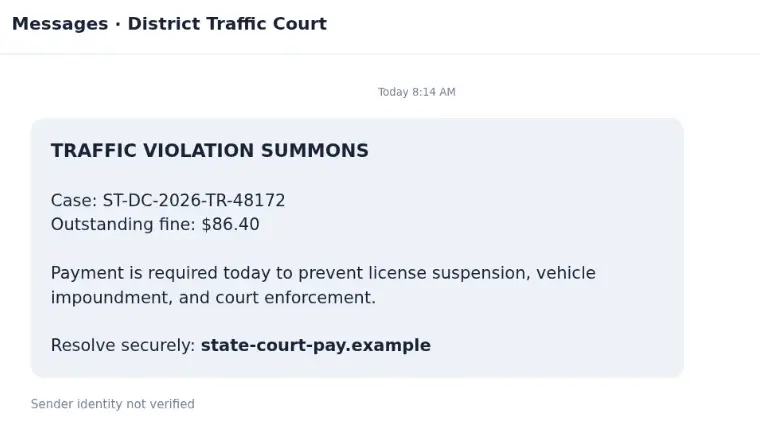
The traffic court text scam is a form of government impersonation and phishing. You receive an unsolicited SMS claiming that a traffic violation, unpaid ticket, toll charge or court matter is associated with you. The message may say that you missed a payment or failed to appear for a hearing and that you now have a limited amount of time to resolve the situation.
The wording varies, but the basic story tends to stay the same. You supposedly have an outstanding traffic matter, the court is about to take action, and you can avoid the consequences by paying through a link or QR code included in the message.
The FTC says these messages may threaten recipients with things such as fines, enforcement action or other consequences if they do not act quickly. The QR code can lead to a fraudulent payment page that attempts to collect credit card or Social Security information, steal money, or potentially deliver malicious software.
That is an important detail because the scam does not necessarily end with the payment. A person who believes they are simply paying a traffic ticket may actually be handing their card information and other personal details directly to criminals.
Why Does the Text Look So Official?
This is the part I think catches people off guard. A scammer does not need to convince you that they are some random stranger asking for money. They only need to make you believe, for a few minutes, that you are dealing with a court.
The fake notices being reported in 2026 have included surprisingly specific information. Maryland courts, for example, warned about messages that referenced the names of a judge, clerk and law enforcement officer and directed recipients toward a supposed show-cause hearing. The messages threatened penalties if the recipient failed to respond.
The U.S. District Court for the District of New Mexico also reported a campaign in June 2026 in which recipients received messages containing an alleged traffic citation, issuing officer, assigned judge, court clerk and case number. The message then threatened an arrest warrant and directed the recipient to a link. The federal court specifically pointed out that it does not handle traffic citations and does not send these kinds of notices by text.
That tells you something important about the way these scams are being constructed. A case number does not prove that a case exists. A judge’s name does not prove that the judge sent the message. A court seal does not make a website legitimate. Even information that looks remarkably specific can simply be copied, invented or misused.
The QR Code Is Part of the Trap
The QR code is probably the most useful feature for scammers because it removes several steps between the frightening message and the payment page. You do not have to type a website address or search for anything. You simply point your phone at the code and follow the instructions.
The problem is that the QR code belongs to whoever created the message. It does not magically become trustworthy because it appears underneath a court seal.
The FTC specifically advises people not to scan QR codes included in these traffic violation texts. If you believe there may really be a ticket or court matter in your name, the safer approach is to find the court independently and check the case through its official website or contact the court using a phone number obtained from a trusted source.
Several courts have issued essentially the same warning. California courts say they will not send links by text to pay traffic tickets, while the Northern District of California says it will not ask for payment or credit card or bank information by text or email.
Can a Real Traffic Ticket Come by Text?
This is where people can get confused, because some courts do use electronic communication for legitimate purposes. That does not mean an unexpected text demanding payment is genuine.
For example, the Hawaii Police Department said in June 2026 that the Hawaii Judiciary can send court appearance reminders by text to people who have opted into that service. However, the traffic-fine messages being reported were fraudulent and were demanding immediate payment while threatening license suspension, arrest, vehicle impoundment and other consequences.
So the question is not simply, “Do courts ever send texts?” The better question is, “Did I knowingly sign up for this notification, and can I independently verify the case through the court?”
An unexpected demand for money is a very different thing from an ordinary court reminder.
The Fake Case Number Does Not Prove Anything
One detail I would not put much confidence in is the case reference itself. Seeing something like “Case No. 2026-TR-43809” can make a message feel legitimate because it resembles the kind of number you would expect on a legal document.
But scammers understand that too.
The U.S. District Court in New Mexico specifically reported fraudulent traffic texts containing alleged case numbers and names of actual judges and law enforcement officers. That is why searching the number, staring at the formatting or checking whether the name sounds familiar is not enough.
If there is genuinely a traffic case against you, you should be able to verify it through the actual court or appropriate government system. The verification should happen outside the text message rather than through the website, phone number or QR code supplied by the sender.
What Happens If You Click the Traffic Court Payment Link?
The outcome depends on the particular campaign, but the danger is usually one of three things: the scammer wants your money, your financial information, or additional personal information that can be used for identity theft.
A fake payment page may ask for your name, address, driver’s license information, Social Security number, credit card number or bank details. You may believe you are filling out a government payment form when you are actually submitting everything directly to the scammer.
The FTC has also warned that QR-code scams can be used to direct victims to malicious websites or software, so there is more at stake than simply losing the amount shown as the supposed traffic fine.
This is why I would not test the link just to see where it goes. There is nothing to gain from interacting with a suspicious court message.
What About the Threat of a Suspended License or Bench Warrant?
The threats are deliberately chosen because they hit a nerve. Most people do not want to discover that their driver’s license has been suspended, and the phrase “bench warrant” can make a person panic very quickly.
Recent scam examples have used threats involving arrest warrants, driver’s license suspension, vehicle impoundment, wage garnishment, civil penalties and even asset seizure. California courts and Nevada courts have both warned about fraudulent notices using this type of language.
The fact that the message sounds severe does not make it legally credible. In fact, the urgency is part of the sales pitch. The scammer wants you frightened enough to skip the one step that would expose the fraud: checking whether the case actually exists.
A genuine legal problem should not require you to trust an unsolicited SMS in order to resolve it.
I Received a Traffic Court Text. What Should I Do?
My advice is simple: do not pay anything through the message. Do not scan the QR code, click the payment link, reply to the sender or call a number included in the text.
Instead, go directly to the official website of the court or government agency involved. If you believe the message might relate to a real ticket, look up the court independently and check its traffic case system. You can also call the court using contact information obtained from its official website.
California courts give essentially the same instructions: verify the ticket through the local court’s traffic website, court case portal or a trusted court telephone number, and only make payment through the official court system or in person.
That extra minute of checking can save you from turning a fake traffic ticket into a real financial problem.
What If I Already Paid the Traffic Court Text Scam?
If you already entered your card details or made a payment, I would treat it as a financial-security issue rather than simply deleting the text and forgetting about it. Contact your bank or card issuer using the number on the back of your card, explain what happened and ask what steps they recommend for protecting the account and disputing any fraudulent transaction.
If you provided sensitive personal information, take steps to protect the affected accounts as well. California’s Attorney General has specifically advised people who clicked suspicious links or supplied information to secure their financial accounts and dispute unfamiliar charges.
It is also worth reporting the scam. The FTC recommends reporting fraudulent traffic-violation texts through its fraud-reporting system, and some courts are also asking victims to report the messages so authorities can track the campaigns.
What I Think Of The Traffic Court Text Scam
The traffic court text scam is absolutely one to take seriously in 2026, not because the messages are especially clever when you slow down and examine them, but because they are built around something people naturally take seriously: the possibility of getting into legal trouble.
What makes this campaign different from an ordinary spam text is the amount of official-looking detail packed into the message. A fake court name, case number, judge, clerk, hearing date and government seal can make a person feel as though they have already been caught and simply need to pay before things get worse. Recent warnings from courts across multiple states, along with the FTC’s April 2026 alert, show that these are not isolated rumors or one person’s strange message.
The safest way to deal with a traffic violation text scam is to step outside the message completely. Do not use its link, QR code, telephone number or contact details to verify the claim. Check the alleged ticket directly through the official court or government system. If there is no case, you have your answer. If there is a real case, you can deal with it through the legitimate channel without giving your money or personal information to whoever sent the text.
In other words, don’t let a fake court notice turn into a real bill. A scary-looking SMS is not proof that you owe a traffic fine, and a QR code is certainly not proof that you are paying the right court.
Checkout The Back Taxes Scam Call, I talked about earlier.