The Ohio BMV text scam is targeting drivers with messages claiming they owe money for an unpaid traffic ticket, parking violation, or toll fine. The texts often warn that failure to pay by a stated deadline could result in a suspended driver’s license, vehicle registration problems, additional penalties, or other legal consequences. For anyone who receives one of these messages unexpectedly, the threat can feel convincing enough to prompt an immediate payment, especially when the message appears to come from an official state agency.
However, the Ohio Bureau of Motor Vehicles (BMV) and other state authorities have warned residents about fraudulent texts impersonating government agencies. These messages are designed to pressure recipients into clicking suspicious links, submitting payment information, or handing over personal details that criminals can use for financial fraud or identity theft. The important thing to understand is that receiving a text about an unpaid ticket does not automatically mean you owe a fine, even when the message includes official-sounding language and threatens serious consequences.
What Is the Ohio BMV Text Scam?
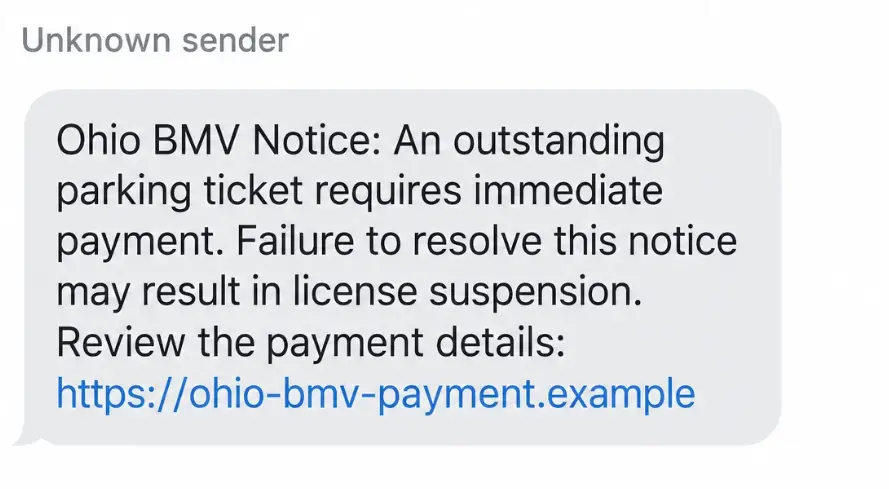
The Ohio BMV text scam is a phishing scheme in which criminals pretend to represent the Ohio Bureau of Motor Vehicles, a traffic enforcement authority, or another government agency. The messages typically claim that the recipient has an outstanding traffic ticket, unpaid parking citation, or toll charge that must be settled online. A link is provided to make payment, often alongside a deadline intended to discourage the recipient from questioning whether the notice is genuine.
Some versions use names such as the “Ohio Department of Vehicles” or refer to administrative codes and supposed legal requirements to make the message look legitimate. Scammers may also copy the language, colors, or general appearance of government notices, making it harder for someone reading quickly on a phone to recognize the deception.
The message may threaten driver’s license suspension, vehicle registration cancellation, increased fines, or other penalties if payment is not made immediately. These threats are part of the pressure tactic. Rather than giving recipients time to verify the claim through an official government website, the sender wants them to react out of fear and follow the supplied link.
How the Fake Ohio BMV Text Message Works
A typical scam text starts with a claim that you have failed to pay a traffic fine. It may include a specific amount, a final payment date, or a statement that your driving privileges will be affected if you do not settle the balance. Some messages are written in a formal tone, while others use urgent language designed to make the recipient feel that there is little time left to act.
The next step is usually a link to a website where you are supposedly expected to pay the outstanding amount. That website may imitate a government payment portal, but it is controlled by the scammers or otherwise intended to collect information from unsuspecting visitors. Depending on the version of the scam, the page may request your name, address, driver’s license details, bank card number, or other personal and financial information.
Even if the requested payment looks relatively small, the potential loss is not limited to the amount shown in the message. Criminals may use stolen card details to make unauthorized transactions, while personal information can be used in further fraud attempts. Some fraudulent websites may also try to obtain additional payments through misleading fees or repeated charges.
The scammers do not necessarily know whether you have a traffic ticket. These messages can be sent to large numbers of people in the hope that some recipients will believe the claim and pay without checking it first. That is why someone who has never received a traffic citation may still get a convincing-looking notice about an alleged violation.
Signs the Ohio BMV Payment Text Is a Scam
One of the biggest clues is the demand for immediate payment through a link included in an unsolicited text message. Legitimate traffic violations are handled through the appropriate court or issuing authority, and a text claiming to be from the BMV should not be treated as proof that a fine exists. A message that threatens to suspend your license unless you pay through an unfamiliar website deserves particular scrutiny.
Pay attention to the website address, too. A fraudulent page may use words such as “Ohio,” “BMV,” “traffic,” or “payment” to appear official, but those words alone do not establish that a website belongs to the state government. Do not assume a site is genuine because it has a government-style logo, an official-looking payment form, or a padlock symbol in the browser. Check the address independently rather than relying on the link supplied by the sender.
Another concern is the way these messages describe the alleged violation. Some use vague wording without identifying a verifiable ticket, while others cite administrative codes or legal provisions that sound convincing but may be fabricated or misrepresented. Poor grammar, an unfamiliar sender number, unusual payment instructions, and a QR code directing you to an unknown website can provide additional reasons to be suspicious. Still, scammers can produce well-written messages, so the absence of spelling mistakes does not make a text legitimate.
Does the Ohio BMV Really Send Texts About Unpaid Traffic Tickets?
Ohio authorities have warned residents about phishing messages that impersonate state agencies and claim that unpaid traffic or toll fines must be paid through suspicious links. The existence of these warnings is a good reason to be cautious whenever an unexpected text threatens penalties for nonpayment.
It is also worth understanding that the BMV and the courts do not perform exactly the same functions. A traffic citation may be handled by a court or the authority that issued it, while the BMV deals with matters such as driver’s licenses and vehicle registrations. A message that combines an alleged traffic fine with threats of immediate license suspension should therefore be verified rather than accepted at face value.
If you are worried that you may genuinely owe a fine, do not ignore the possibility simply because you received a suspicious text. Instead, look up the relevant Ohio government agency or municipal court independently and use its published contact information. You can begin with the official Ohio Bureau of Motor Vehicles website. If the matter concerns a traffic citation, contact the court or issuing authority responsible for that citation. This allows you to check your actual status without exposing your financial information to an unknown sender.
What to Do If You Receive an Ohio BMV Scam Text
If an unexpected message claims that your driver’s license will be suspended unless you pay an outstanding ticket, avoid clicking the link, scanning the QR code, or replying to the sender. Do not provide your driver’s license number, Social Security number, bank details, or card information. You can verify the claim through official channels without interacting with the suspicious message.
If you have established that the text is fraudulent, report it using your mobile carrier’s spam-reporting process or forward it to 7726 (SPAM) where supported. You can also report phishing attempts to the Federal Trade Commission. Keep a screenshot of the message and the suspicious website address if you need to provide evidence, but do not revisit the site unnecessarily.
What if you have already clicked the link? Simply opening a webpage does not automatically mean your identity or bank account has been compromised, but you should close the page and avoid entering any information. If you submitted payment details, contact your bank or card issuer promptly, explain what happened, and ask about blocking the card, disputing unauthorized transactions, or taking other protective measures. If you entered a password, change it through the legitimate service and update it anywhere else you reused it. If you provided sensitive identity information, consider the appropriate identity-theft reporting and credit-protection measures.
Anyone who has already paid should not assume that the money is necessarily gone for good, but should act quickly. Contact the financial institution or payment provider used for the transaction and ask whether the payment can be stopped, reversed, or disputed. Save the message, transaction records, receipts, and any communication with the sender.
Is the Ohio BMV Text Scam Legit?
The fraudulent Ohio BMV text messages are a phishing scam, not reliable proof of an unpaid traffic ticket. They exploit drivers’ fear of losing their licenses or facing additional penalties to persuade them to visit fake payment websites and hand over money or personal information. The use of official-sounding agency names, supposed legal codes, urgent deadlines, and government-style webpages does not make the claims genuine.
The safest response is to verify any alleged fine directly with the appropriate Ohio government agency or court, using contact details you find independently. Do not pay through a link in an unexpected message simply because it threatens legal consequences. A few minutes spent checking the claim could save you from fraudulent charges, stolen personal information, and the hassle of dealing with identity theft.
If you live in Ohio or have recently received a text about an unpaid traffic ticket, parking citation, or toll violation, treat an unsolicited payment demand with caution. The message may be designed to look official, but you do not need to follow a suspicious link to find out whether you actually owe money.
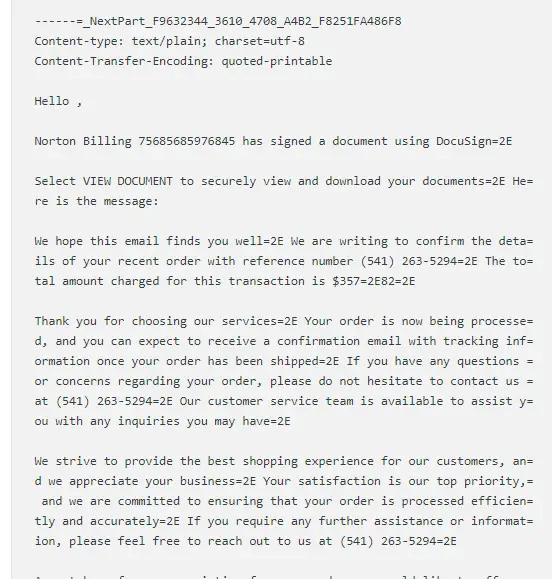
Check out The Docusign Email Scam, I talked about earlier.